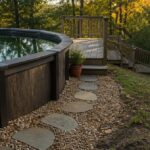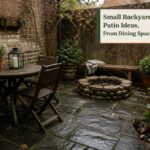
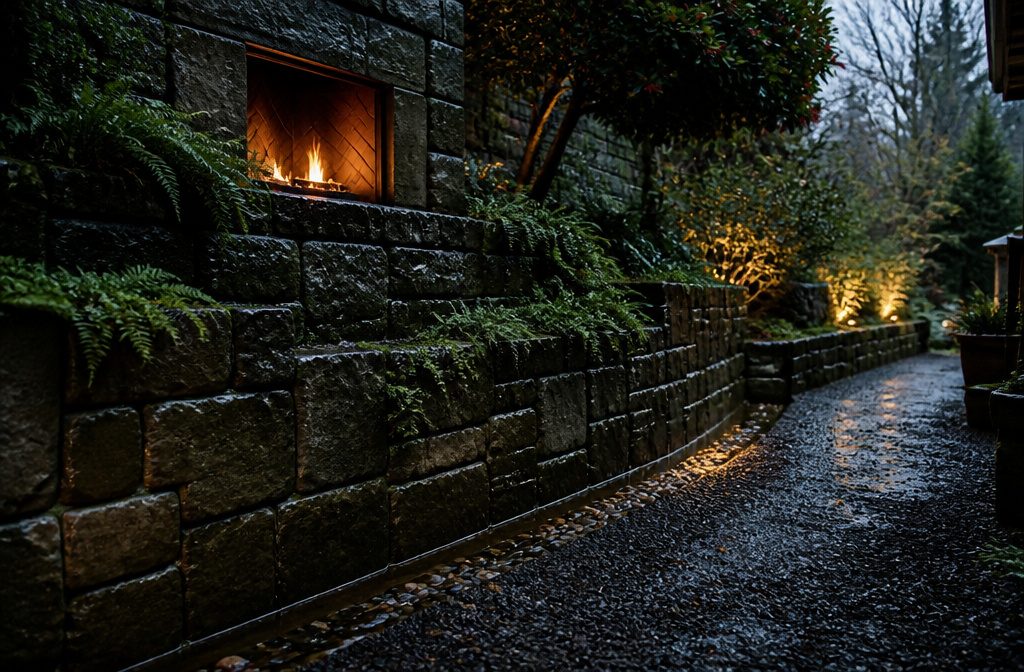
The walls here range from a low bed edge to a tall back wall with a gas fireplace set into it, and your slope decides which one fits.
Steep sites often need a professionally engineered wall, and a wall that traps water is the likeliest to fail, so watch where water runs after a rain.
1. Small Low Garden Walls
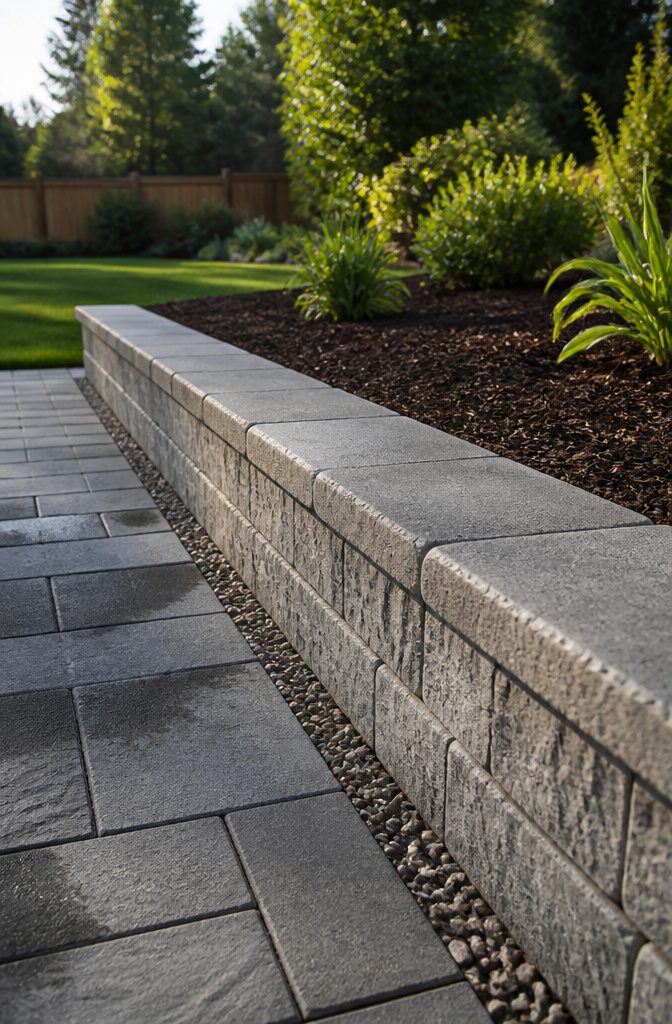
Every retaining wall holds soil, but a small one also shapes the space around it and adds visual interest.
Low walls outline planting beds so soil and mulch stay put. They frame the edge of a patio and mark a gentle change from one level to the next, without the heavy presence of a tall wall.
A short wall still needs a plan for drainage and erosion control. Water that pools behind it can push soil out through the face, so build that in from the start.
Before you commit, preview the wall in 3D with the Belgard Design Studio. A Belgard Authorized Contractor can then plan, design and build it with you.
Recommended Products
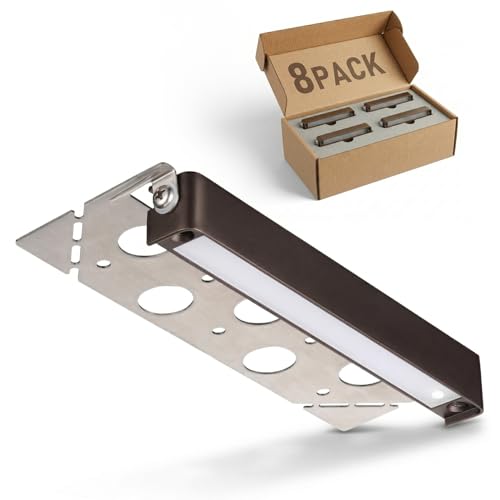
Widely Used: Powered by 12-24V AC/DC, this LED low voltage landscape light can be used to light barbecue fire pits, landscape steps, retaining walls, decks, rock brick column, outdoor kitchen, flowerbeds, and masonry walls. This hardscape paver light can be rotated to fits more applications

Builds strong retaining walls and stonework

【Easy 1-Minute Replacement】 No more prying up heavy stones! Unlike traditional hardscape lights that require destroying masonry work to fix, our innovative modular design lets you swap the LED engine by simply removing 3 screws. The heavy-duty stainless steel plate and wiring stay permanently secured under the blocks. True hassle-free maintenance for your outdoor retaining walls and seating walls.
2. Terraced Walls for Slopes
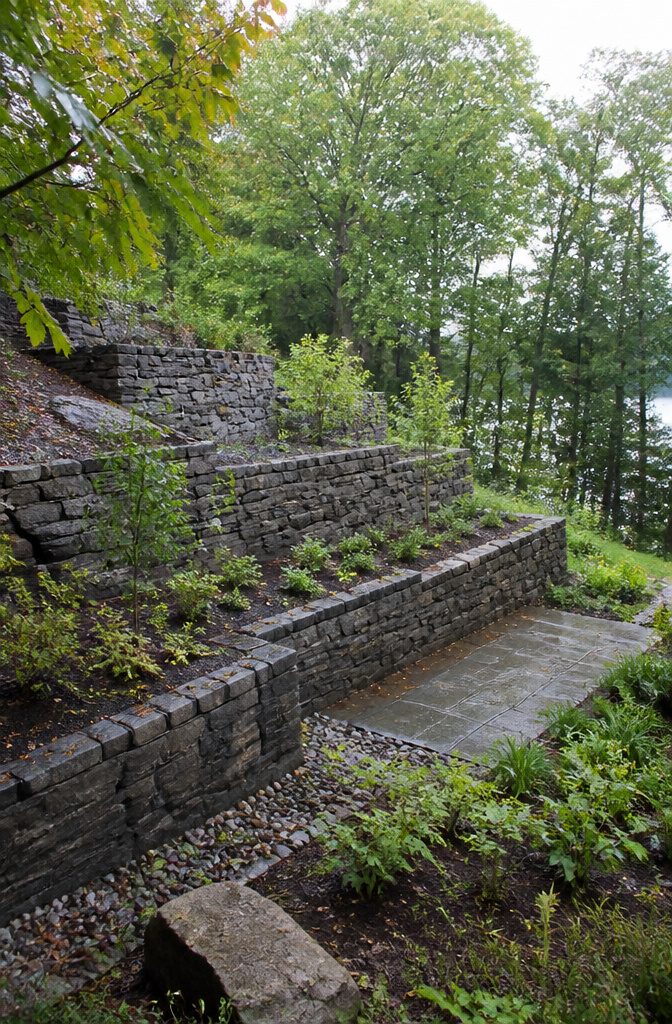
A steep slope gives you little room to set a chair, a bed or a grill.
Stepping the hill into level terraces, with a wall holding the soil behind each one, creates flat ground for a patio, garden beds or a walkway.
Terraces also slow water as it runs downhill, so more soaks in and less carries soil away. That reduces erosion and improves drainage.
Walk the slope after a rain and note where water pools or runs. Assess the slope and drainage before you buy any material, because a wall that traps water behind it is the one most likely to fail.
Steep sites often need a professionally engineered wall, and that is worth hiring out rather than guessing.
Recommended Products

✅【Retaining Wall Fiberglass Geogrid】The Retaining Wall Fiberglass Geogrid boasts a reliable tensile strength of 50 KN, whereas plastic geogrids fail to provide tensile strength or soil reinforcement. Our Fiberglass Geogrid is specifically designed for slope reinforcement and crack control in asphalt and concrete pavements.

Adds strength and longevity to your wall

Geogrid for Retaining Wall: Designed for demanding applications like retaining walls and slope stability, this bi-directional geogrid evenly disperses loads to minimize soil deformation, prevent settlement, and enhance overall structural integrity. The 1.5" x 1.5" aperture size delivering reliable performance for both residential landscaping and civil engineering projects.
3. Planter Walls and Flower Beds
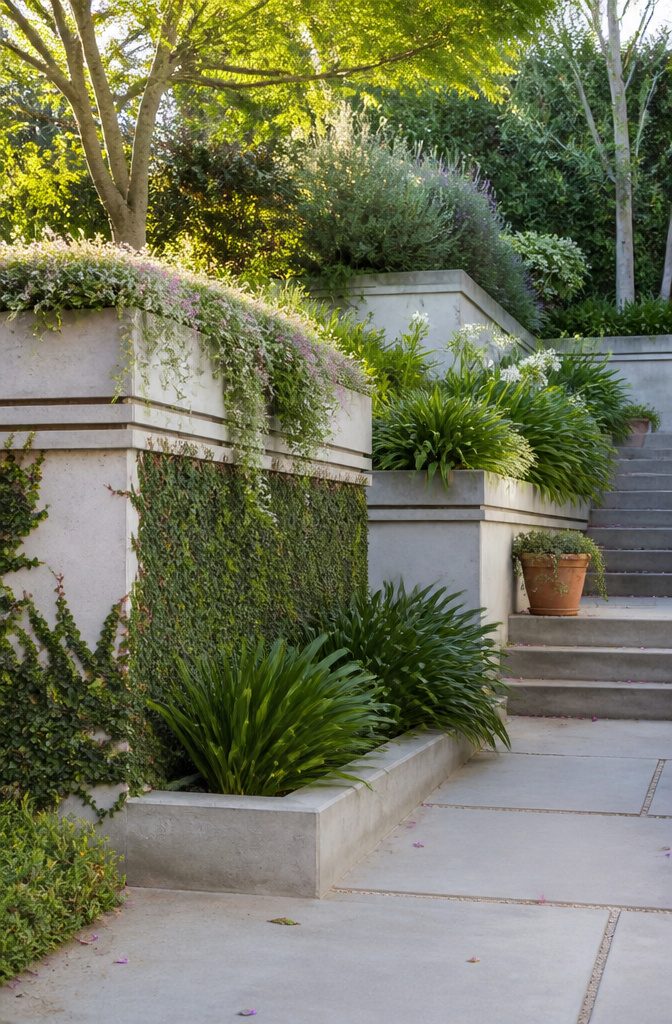
Plants make a wall look finished.
Build the planters into the structure, as in an Oakland yard where concrete walls, built-in planters and stairs got one art deco–esque treatment, and the planting reads as part of the design instead of an add-on.
Layer heights in the bed: trailing plants that spill over the wall top, mid-height perennials in the middle, and shrubs behind. On a slope, the roots in those beds hold soil and help prevent erosion.
For a wall you’d rather not look at, creeping fig (Ficus pumila) planted against it grows into a green curtain that covers worn or cracked concrete. It costs far less than rebuilding the wall.
Recommended Products

Pack of 2 semi circular wall hanging planters. Rustic Indoor and outdoor decoration.

This contemporary set of half-moon stoneware planters features an intricately embossed hatch design

Design: Wall mounted flower pots are suitable for indoor and outdoor decoration or office walls, saving space. It is also suitable for indoor plant wall pots and vertical wall flower pots
4. Walls With Steps
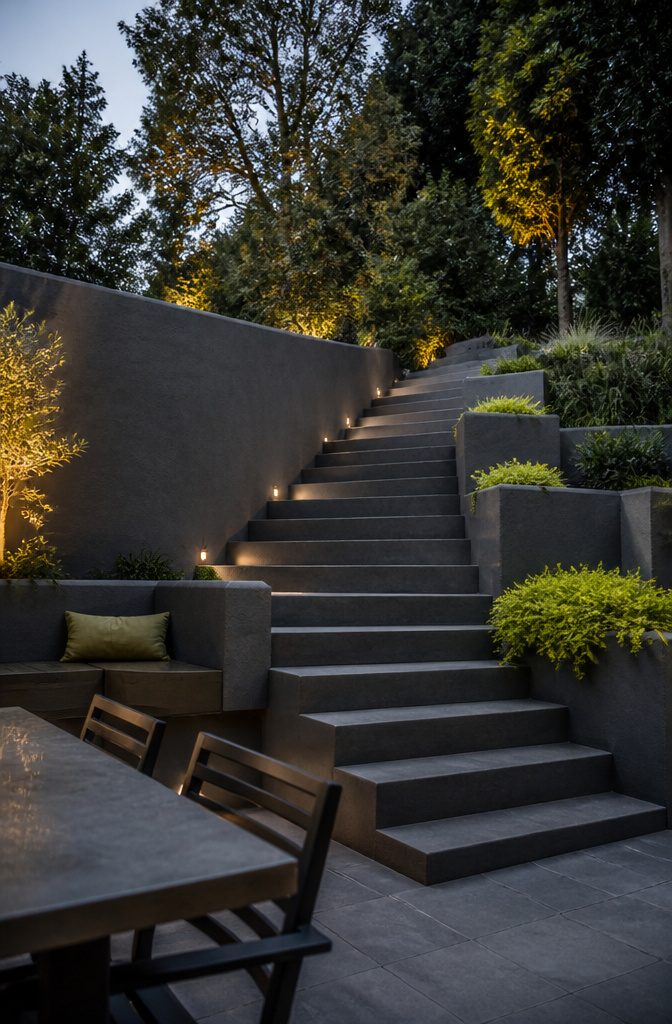
Steps built into a retaining wall join two elevations and turn a slope you work around into one you walk through.
They also make the yard easier to use for anyone who finds a steep grade hard. Treat the stairs as a feature of the wall, not something to hide.
One Oakland yard does this with a grand staircase set among concrete walls and built-in planters, all given an art deco–esque look. The stairs double as the backdrop for outdoor meals.
On another Oakland hillside, charcoal concrete walls and steps give a neutral base that makes chartreuse accents stand out. Stairs are also one of the places where lighting helps most after dark, so plan for it while you build.
Recommended Products

【Complete Low-Voltage Landscape Lighting Kit】includes 8 RGBW step lights, 1 transformer, 2 remotes, and a 65ft low-voltage wire. The wiring uses DC connectors, making plug-and-play and the entire installation process very simple. No need to purchase additional tools and accessories

[All-in-One Kit, Easy Installation] HIBOITEC's LED landscape lighting kit includes everything needed. No need to purchase additional accessories. The weatherproof (male and female) connect quickly and securely—no tools or wiring required—making expansion and maintenance a breeze.The kit feature integrated LED light sources with a lifespan of up to 40,000 hours, ensuring long-term, stable performance, choice for permanent outdoor lighting.

.✔ 2.5W deck LED lights,cast aluminum construction outdoor deck lighting low voltage outdoor landscape lighting,equivalent to 25watt halogen bulb.Landscape lighting 12v dock lights,deck railing lights,4x4 deck fence post lights wall mounted light,outdoor stair step lights,landscape deck lights.Saving up to 90% energy electric bill
5. Built-In Seating Walls
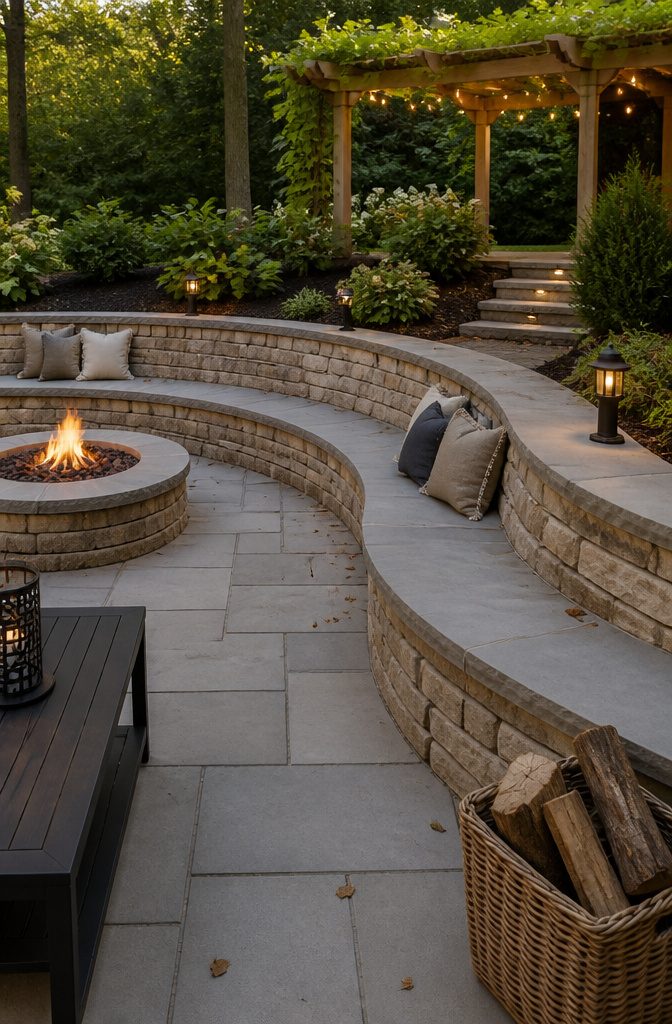
A wall that doubles as a bench removes the need for chairs, which matters most in a small or medium yard where loose furniture eats floor space.
Run it around a patio or fire pit and the wall does two jobs: it marks where the gathering area ends and doubles as permanent seating. The same idea works beside terraces, outdoor kitchens, pergolas, and pools.
Natural stone is a good material for it because it lasts and needs little upkeep.
Outdoor pillows and a few lamps make the wall comfortable for evenings outside. To make the wall look like part of the patio, match it with stone treads, porcelain pavers, or tumbled pavers.
6. Walls With Water Features
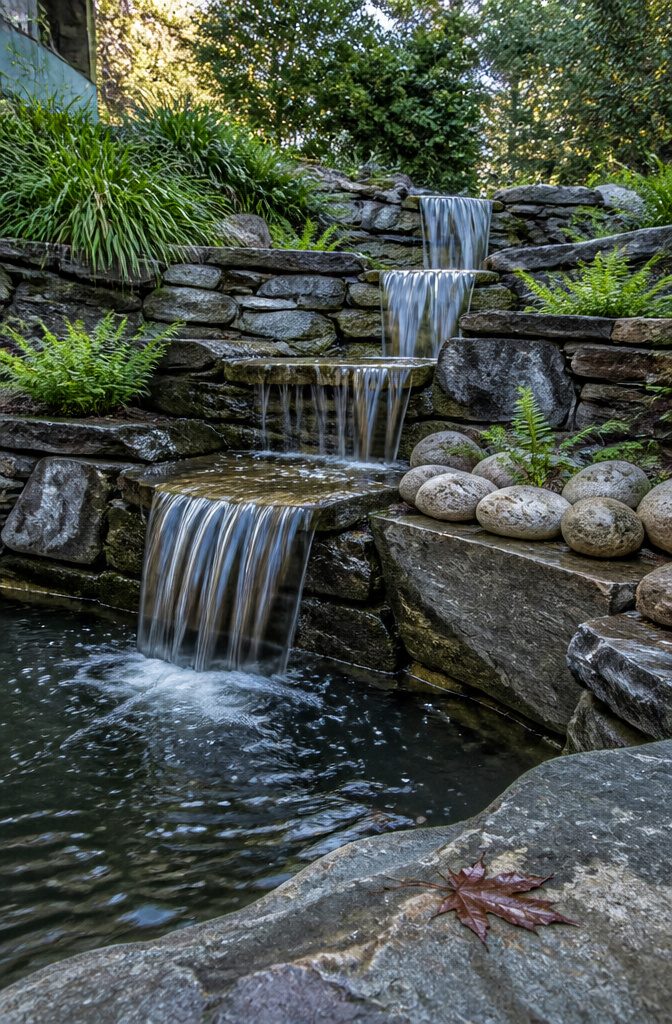
A retaining wall that holds back a slope can also carry water down it.
Tiered walls give a cascade its steps, with each level acting as a ledge for a waterfall to spill over. The stonework stops being background structure and becomes the focal point of the yard.
Moving water adds something stone can’t. The sound carries across the yard, and the motion pulls the eye toward the wall.
This idea suits a slope that already needs tiers. A wall stepped down the grade is the natural frame for a waterfall, while a single low wall gives the water little height to work with.
Plan the water path together with the wall, because the wall’s structure shapes the flow.
Recommended Products

【Upgrade Size】Aulanto plus-size solar fence lights extend the length of the middle product:(4.13 inches ➡ 5.91 inches), from 3 led beads ➡ 5 led beads, The solar panels are larger than before that can charge faster and store more solar power and illuminate a wider range. Just use two screws (included) or double-sided tape(not included)can quick fasten the solar wall lights to any flat surface like fence, wall, step, handrail, railing, etc.

Widely Used: Powered by 12-24V AC/DC, this LED low voltage landscape light can be used to light barbecue fire pits, landscape steps, retaining walls, decks, rock brick column, outdoor kitchen, flowerbeds, and masonry walls. This hardscape paver light can be rotated to fits more applications

Widely Used: Powered by 12-24V AC/DC, this LED low voltage landscape light can be used to light barbecue fire pits, landscape steps, retaining walls, decks, rock brick column, outdoor kitchen, flowerbeds, and masonry walls. This hardscape paver light can be rotated to fits more applications
7. Walls With Built-In Lighting
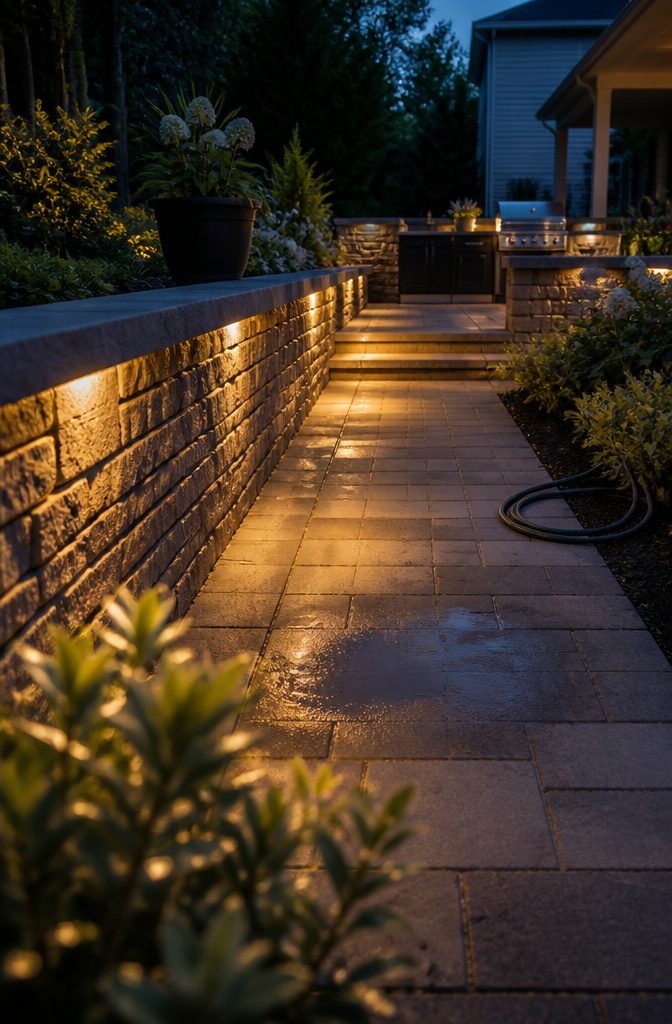
LED strip lighting tucked under the wall cap washes light down the face of the stone, so every joint and surface texture shows after dark.
Recessed fixtures set into the wall do a similar job at a lower height, and they can mark a path or a seating area.
Choose warm white. It flatters natural stone and gives the yard a cozy feel.
Lighting also makes the yard safer. Lit steps, patios, and walkways let you see where the edges are at night.
This matters most where a wall sits near an outdoor kitchen, a fireplace, or a pool. Buy energy-efficient LED fixtures with weather-resistant housings made for outdoor use.
8. A Sunken Patio Wall
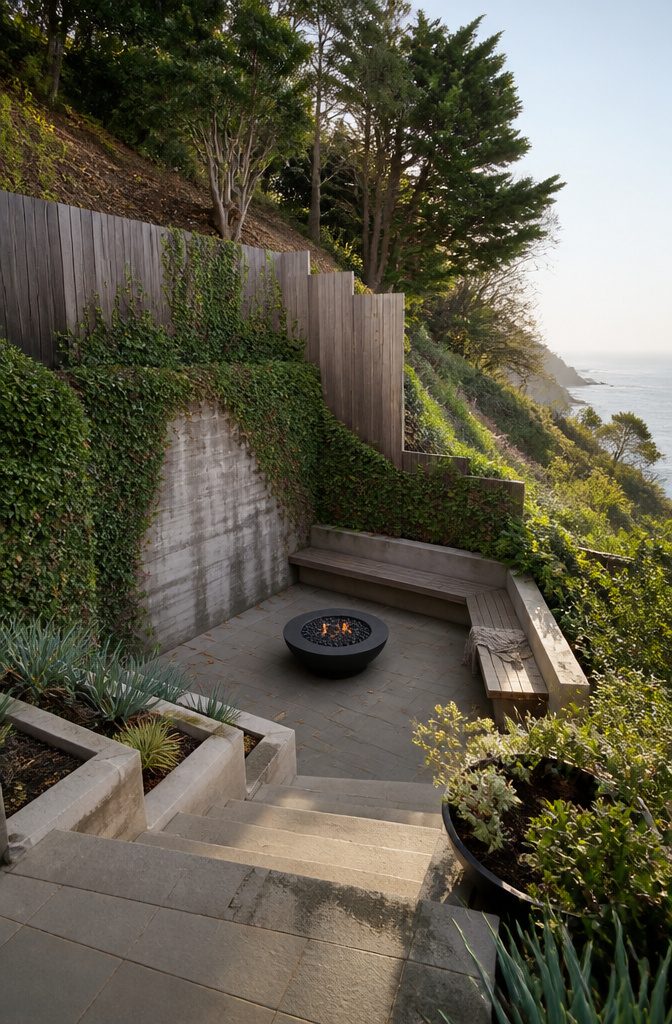
A house set into a hillside already has a way to gain outdoor space: cut into the slope and let a retaining wall hold the earth back.
One home near the Southern California coast had only a tiny, crumbling patio out back. Landscape designer Ryan Prange rebuilt it as a sheltered patio that feels roomier than it is.
He hid part of the old broken concrete wall behind a wooden screen and covered the rest with creeping fig (Ficus pumila) planted against it.
A damaged wall can become the green backdrop rather than something you have to tear out. He then repaved and planted the floor, tucked seating into the corner, and added built-in benches and a gas firepit.
Recommended Products

{Premium Material}: Our garden wall planters bags choosing high-quality felt materials with good air permeability can better store and release water to promote healthy plant growth. It is lightweight, sturdy, convenient, foldable, durable and anti-aging.

SPACE-SAVING VERTICAL GARDEN – Create a lush green wall with 12 plants in a compact 23.5"L x 25.5"H x 5.5"D frame, perfect for small apartments, patios, or balconies.
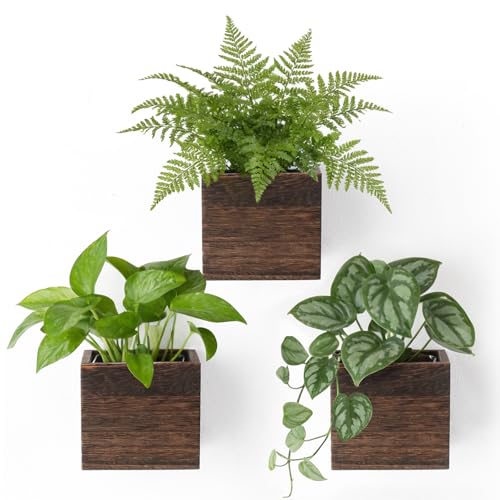
Complete Set & Ready to Use: A set includes 3 wooden square flowerpots and 3 transparent plastic boxes (Note: Plants are not included). The size of the wooden flowerpot is 4''×4''×3.5", and the size of the transparent plastic box is 3.1''×3.1". It comes with all the necessary accessories and can be used after simple installation
9. Walls as Outdoor Rooms
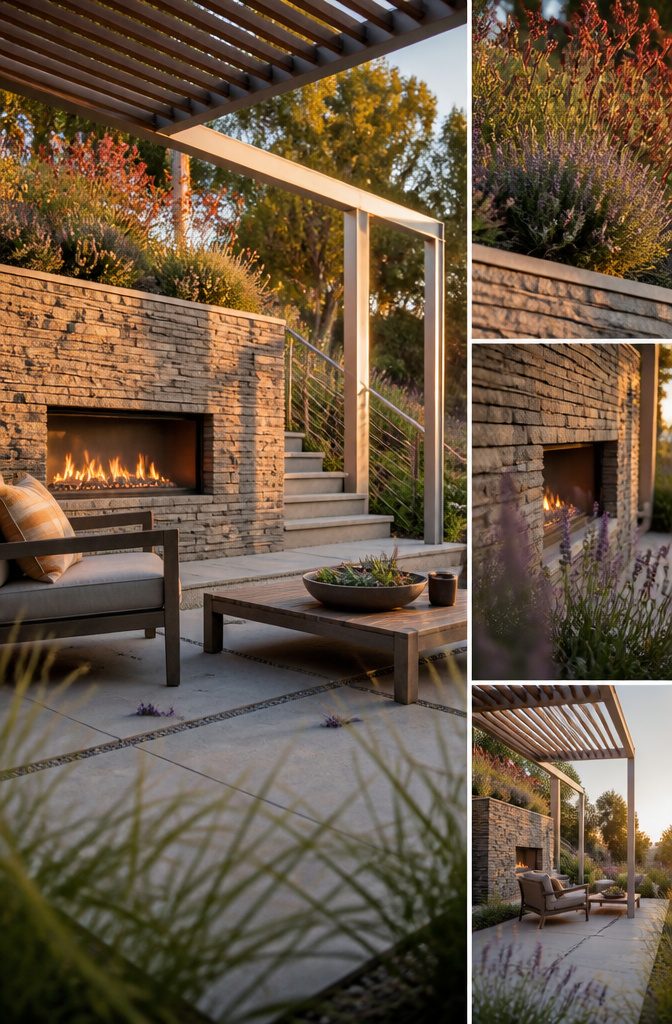
A tall retaining wall works best as the back wall of a room.
In a Danville, California garden, a gas fireplace is set right into the wall, so the grade change becomes a lounge instead of something to screen with plants.
The slope above the wall does its own work. Kangaroo paws, lavender and penstemon tolerate dry spells, and their roots double as erosion control on the slope.
A second approach frames the wall with a custom-fabricated aluminum arbor topped with redwood slats.
Painting the arbor silver to match the wall sconces ties the structure to the wall, and the pair makes a clear backdrop for stairs and outdoor meals.
Recommended Products

Modern horizontal deck sconce features a slim rectangular silhouette with integrated LED technology, delivering sleek architectural illumination for decks, steps, patios, retaining walls, and outdoor living areas
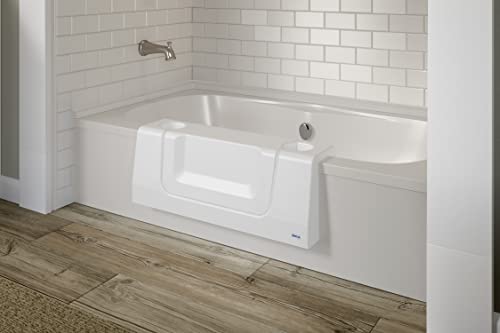
Dual-Function Design Converts your existing bathtub into a safer step-through shower while preserving the ability to enjoy a full bath.

A modern and stylish design big DIY wall clock. Sleek, minimalist look that blends wall with modern decor. 3D mirror effect, adds a reflective, elegant touch to any room, enhances room aesthetics. The frameless design allows the clock to effortlessly complement any environment. Silent and powerful quartz movement. Premium materials, includes gold color coated metal hands and a movement cover, and designed Arabic numeral markers made of EVA wall sticker with gold color mirror-finish acrylic surface
10. Natural-Stone Walls
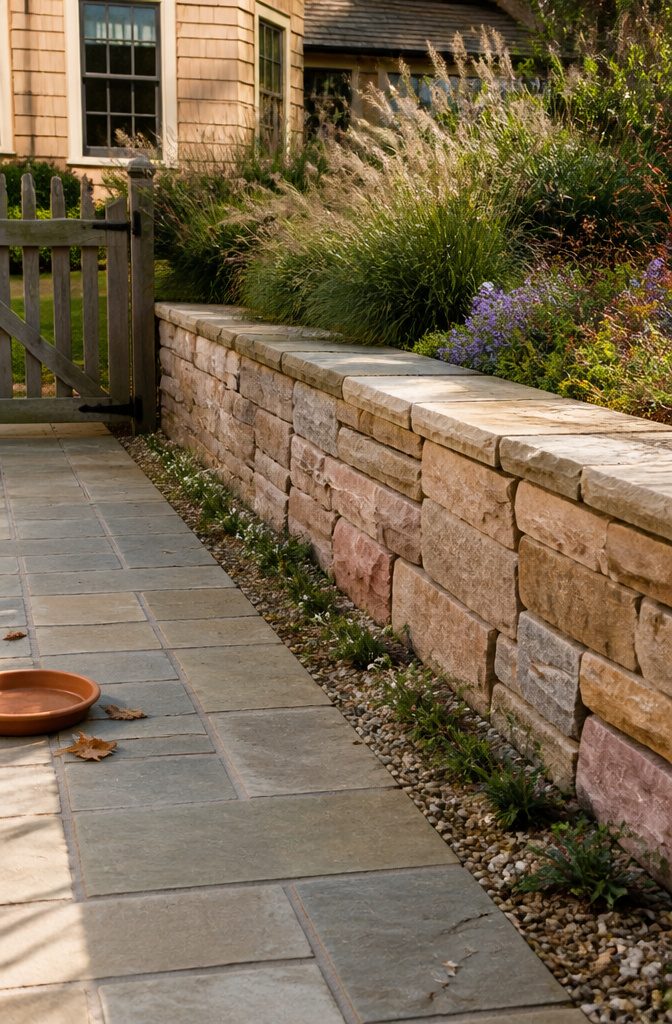
Natural stone holds up to big temperature swings and moisture, and because no two pieces match in color or texture, the wall blends into the plantings around it. Each type of stone leans toward a different look.
Sandstone is warm-toned and slip-proof, so it works where a wall meets a patio or walkway edge that feet and hands will touch.
Limestone is light-colored and reads as modern, which suits clean-lined houses. Granite is the durable pick for walls that will see hard use.
Between them, let your budget and your home’s architectural style decide. Warm sandstone sits easily against a traditional house, and pale limestone looks right beside a contemporary one.
Recommended Products

HEAVY DUTY 8 OZ GEOTEXTILE FABRIC: Heavy duty non woven polypropylene drainage and filter fabric for French drains, retaining walls, road stabilization, erosion control, landscaping, rip rap, geocell, and construction projects.

No cutting concrete wall block, timbers or stone
HEAVY DUTY 8 OZ GEOTEXTILE FABRIC: Heavy duty non woven polypropylene drainage and filter fabric for French drains, retaining walls, road stabilization, erosion control, landscaping, rip rap, geocell, and construction projects.
11. Stacked-Stone Walls
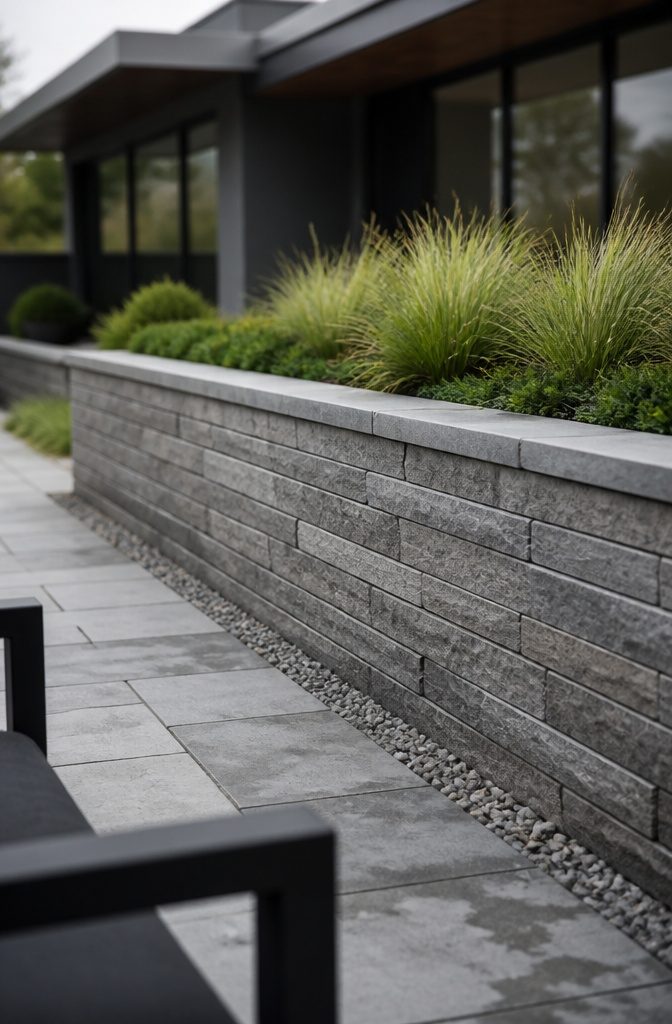
Tight, orderly stacking is what makes this wall read as modern.
The straight lines echo the minimalist features of a contemporary house, and a loose, irregular wall tends to look out of place against them. The stone still adds texture and depth, so a plain facade gets some warmth without clutter.
Keep the palette narrow: gray, beige, charcoal, or a warm sandstone tone.
These colors suit minimalist gardens, outdoor kitchens, and patios. If the budget is tight, build a short feature wall beside a seating area or along a pathway instead of walling the whole yard.
Choose stone that handles both hot and cold weather, since the clean look only lasts if the courses stay put.
12. Curved Walls
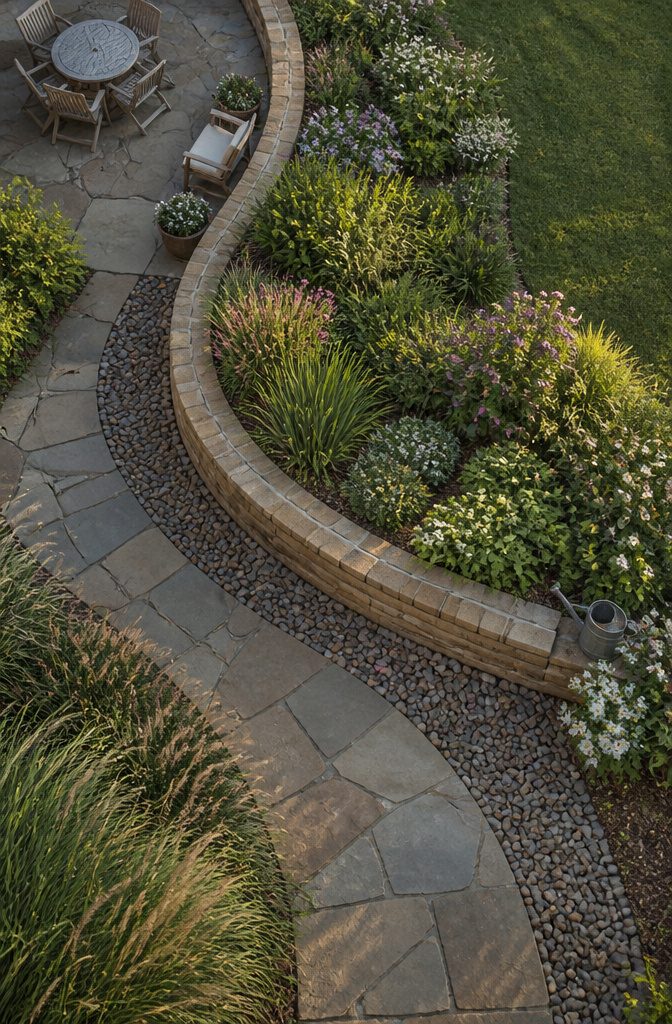
A curved wall softens a yard in a way a straight run can’t.
The flowing line reads as a natural form, and it draws people along its length, so a path or lawn edge feels like a route instead of a boundary.
It also makes a smoother transition between a patio, a lawn and a planting bed.
Sandstone, limestone and fieldstone are the most popular stones for curved walls.
Their natural texture and color variation reinforce the shape of the curve. Plant flowers or ornamental grasses along the face, or lay a band of river stone at the base, to add texture and seasonal color.
Curves suit cottage gardens, contemporary yards, curved patios and poolside plantings.
13. Rustic Boulder Walls
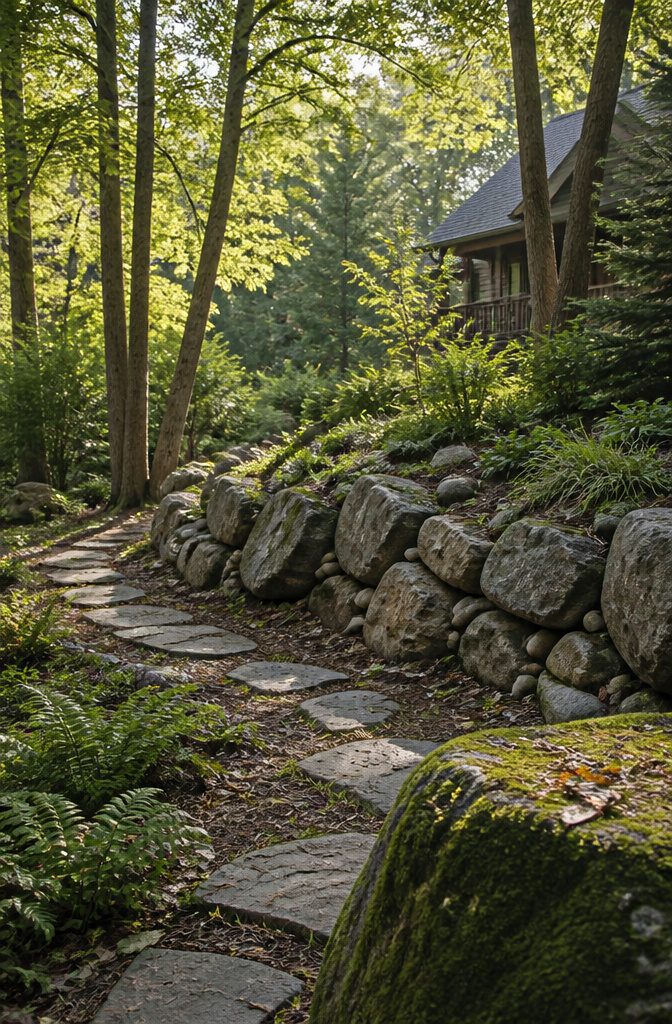
Irregular boulders give a wall a rough, informal look that blends in as if it was already on the site.
That makes them a good fit for rural homes, woodland gardens, lakeside properties and mountain retreats. No two boulders share a shape or texture, so no two walls look alike, and cut blocks can’t match that.
Boulders also hold back a sloped garden without making it look engineered. Pair the wall with local plants, ornamental grasses and riverstone for a low-maintenance planting.
A natural stone path or stepping stones alongside tie the wall to the rest of the yard. Skip this style in a small, formal yard, where the rough edges will look out of place.
14. Gabion Walls
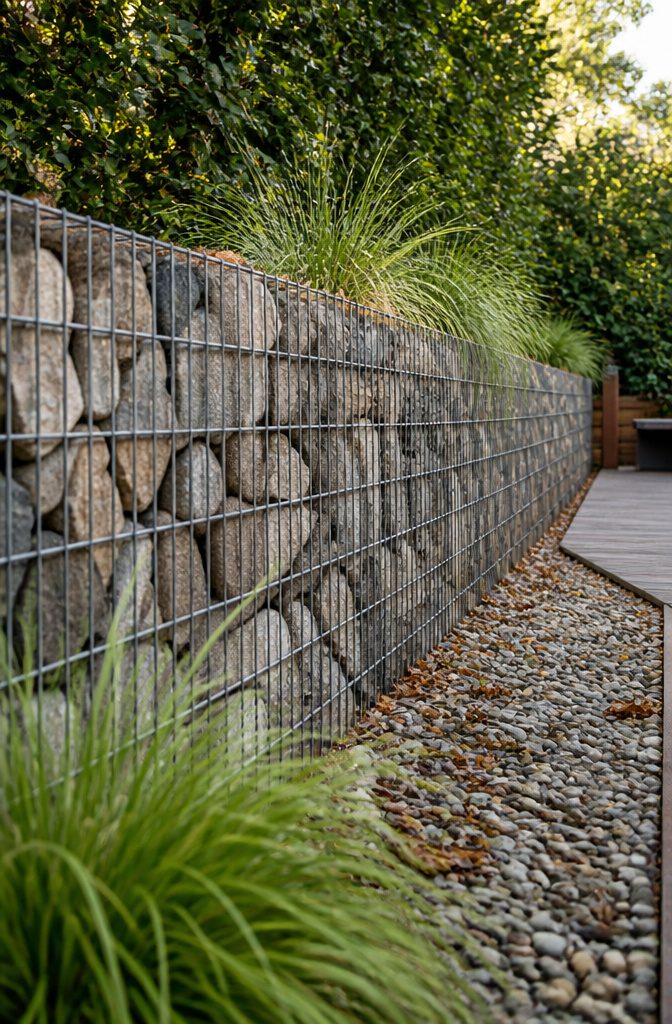
A gabion wall is a wire-mesh cage packed with natural stone, and the look comes from that pairing: crisp metal grid lines around loose, uneven rock.
Mortared walls hide their joints, and stacked walls depend on how each stone fits its neighbor. A gabion leaves the cage in plain view, so the wall reads as industrial and contemporary.
The fill sets the mood. Large stones give a dramatic, chunky face, while small stones give a finer, more even one.
If the wire feels too hard-edged for your yard, plant riverstone or decorative gravel beside the wall to soften it. Gabions suit sloped backyards, garden boundaries, and property divisions.
15. Mixed-Material Walls
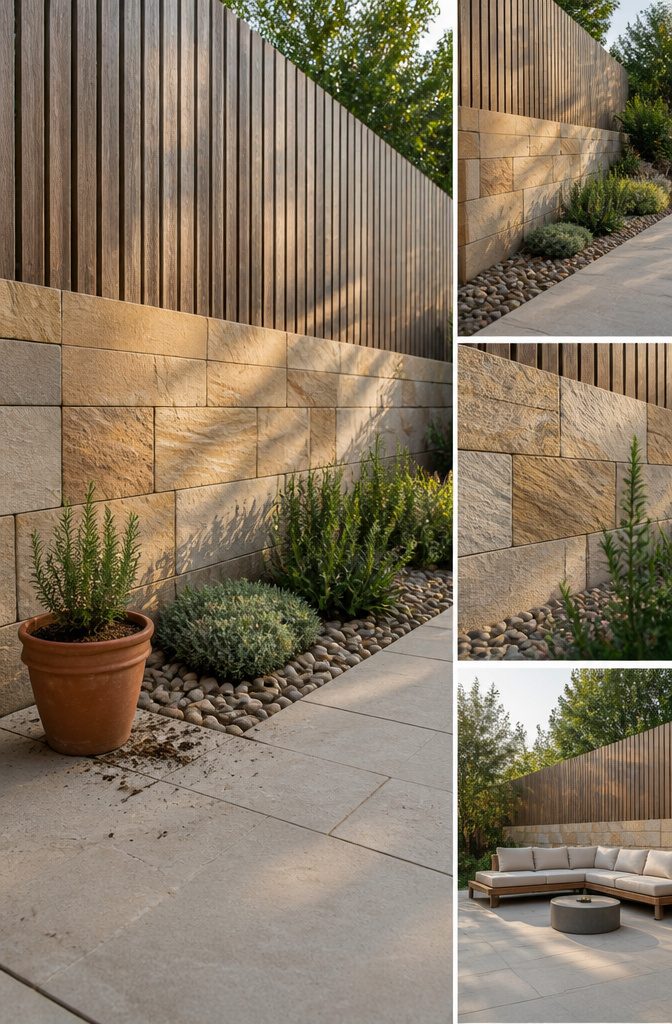
Pairing stone with a second material adds contrast and marks where one zone ends and the next begins. These five combinations work:
- Sandstone and wood: wooden screening above or beside a stone wall gives a cozy yard a contemporary edge.
- Limestone and porcelain paving: put the porcelain on the patio next to the wall, since it is rarely the wall itself.
- Granite and decorative gravel: a good fit for drought-tolerant yards.
- Natural stone and riverstone: riverstone along the base helps water drain and looks more natural.
- Tumbled pavers and garden beds: the beds soften the hard edge of the wall.
Stone can also frame planter boxes while porcelain handles the patio. Stick to one consistent color palette across all the materials, or the yard looks busy instead of unified.