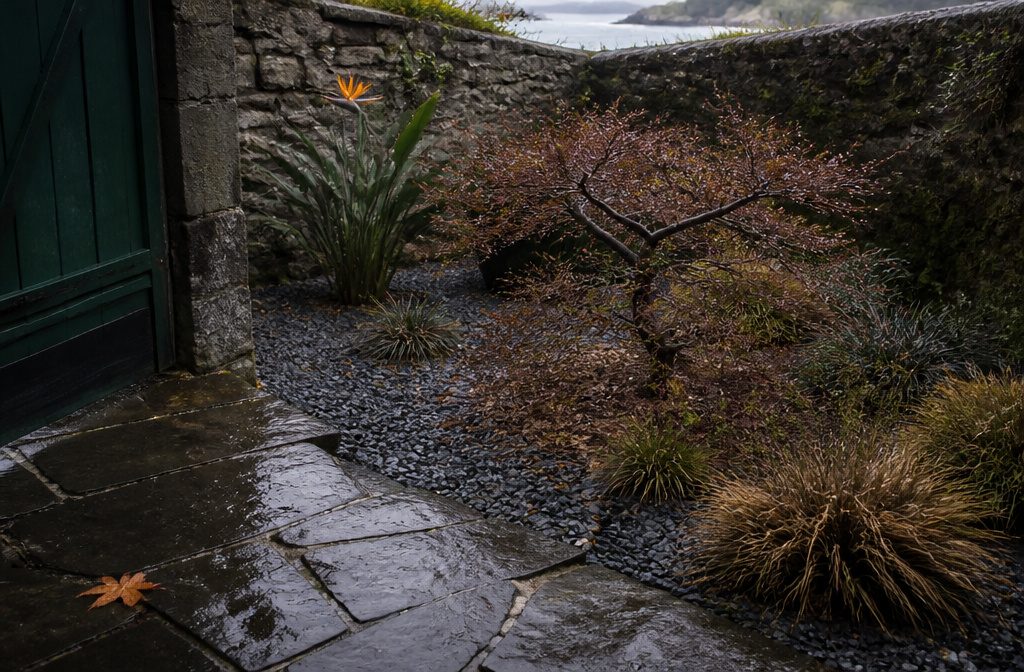
The designs range from gravel yards with a few cactus to beds packed so full of palms and bird of paradise that almost no ground shows.
Your climate picks the end you can plant: true tropicals need a mild climate or winter protection, and even the ‘Butterfly’ Japanese maple is rated only for zones 5 through 8.
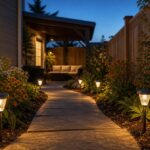
1. Sidewalk Planting With Accents
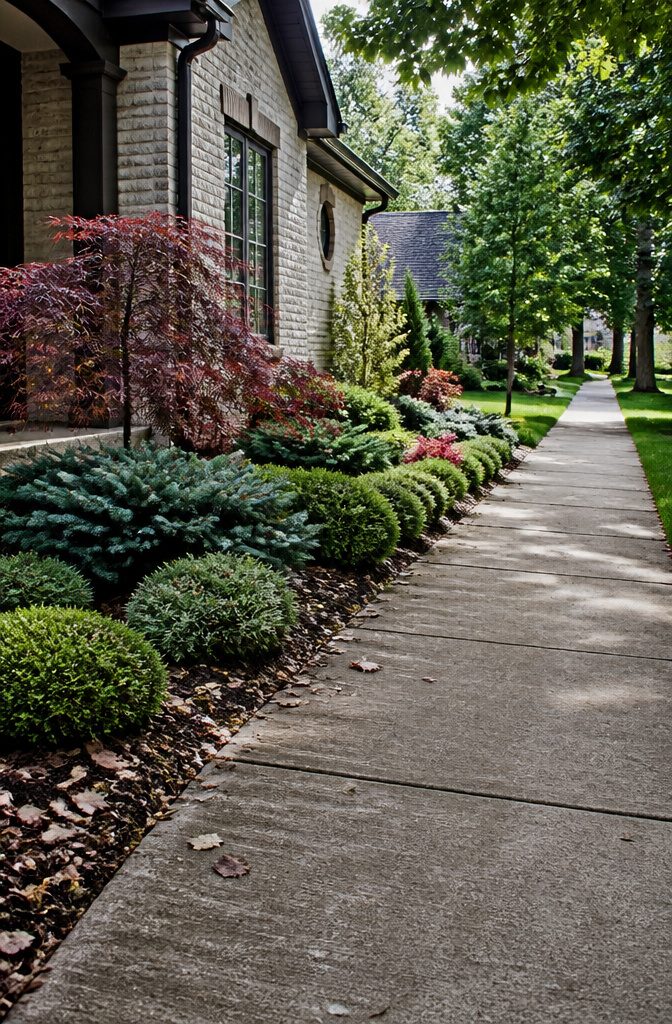
A walkway bed doesn’t need to be symmetrical; repetition matters more. Plant two Japanese maples as specimens: weeping ‘Crimson Queen’ in front, upright ‘Butterfly’ behind.
Repeat low evergreen junipers along the path and tuck colorful accent plants between them. ‘Blue Rug’ and ‘Green Mound’ hug the ground, keep weeds out, and suit the spots under the maples. ‘Table Top’ is low, slow-growing, and easy to maintain.
‘Butterfly’ grows slowly but can reach 10 feet or more if left untrimmed, so keep it cut back from the walkway.
It is rated for zones 5 through 8, so check your zone before buying. Pull out any overgrown plant nearby so the maple stands out.
Recommended Products

Amethyst Myst Heuchera features a silvery cast over stunning amethyst foliage.

Brand:PERENNIAL SEEDS, Country/Region Of Manufacture:United States

For best results, plant in USDA Zone:4-8 - Mature size: 14-24in H x 20-26in W
2. Group and Repeat Plants
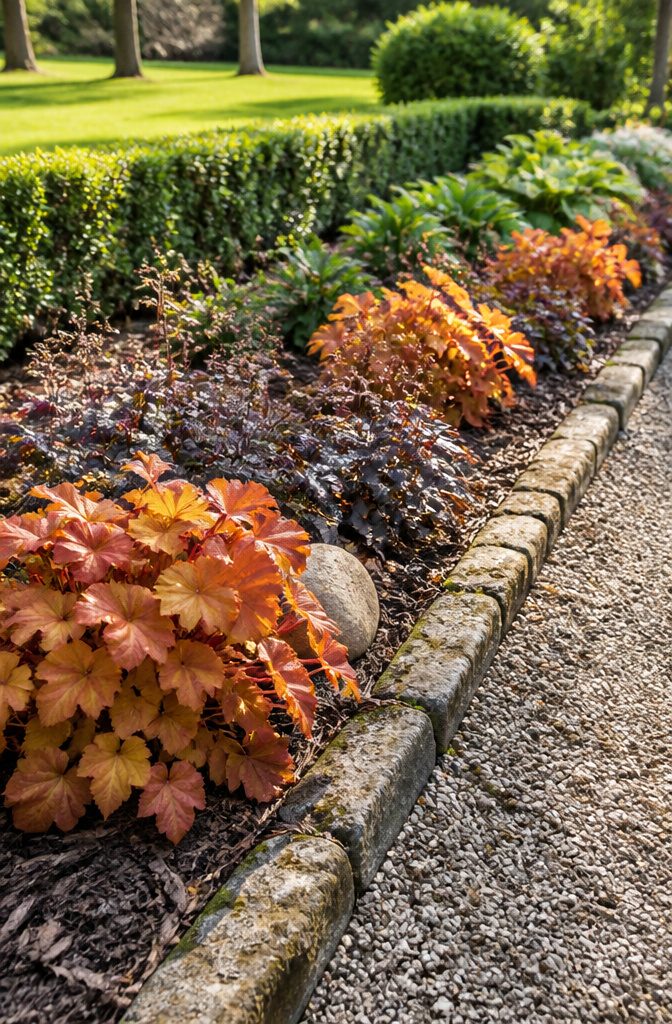
A single plant dotted here and there reads as clutter. The same plant in a group of 3, 5, or 7 reads as a drift.
Treat odd numbers as a loose rule, not a measuring stick. Then repeat the same grouping further down the bed, and the eye links the clumps into one planting.
Heuchera (coral bells) works well in repeats because leaf color carries the pattern. Dark-leaved types do fine in sun, and burnt orange ‘Caramel’ loves it.
Leaves with a lot of yellow are the risk. ‘Citronelle’ won’t tolerate sun, and ‘Amber Waves’ does only okay. Put 3 ‘Caramel’ at a sunny spot, repeat the clump down the bed, and save the yellow ones for shade.
Recommended Products

Heavy Duty Rake: Small garden leaf rake made of durable steel is more durable than plastic rakes. 11 Metal 0.27” tines allow you to work in lawn and garden without tines falling out, damage, fracture, corrosion

Unique shape design: the butterfly and leaf pattern design on the corner bracket of the garden raised bed is more close to your idyllic style, as well as the wave edge design makes your garden vegetable planter box look more energetic. These made building the raised bed simpler

Heavy-Duty Galvanized Steel: The 5x5x1 ft Galvanized Raised Garden Bed Kit is made with three-in-one layering consists of a durable steel core, followed by a protective galvanized layer, and topped with a robust colored coating, enabling it to withstand prolonged exposure to elements like sunlight, rain, and snow.
3. Island Bed
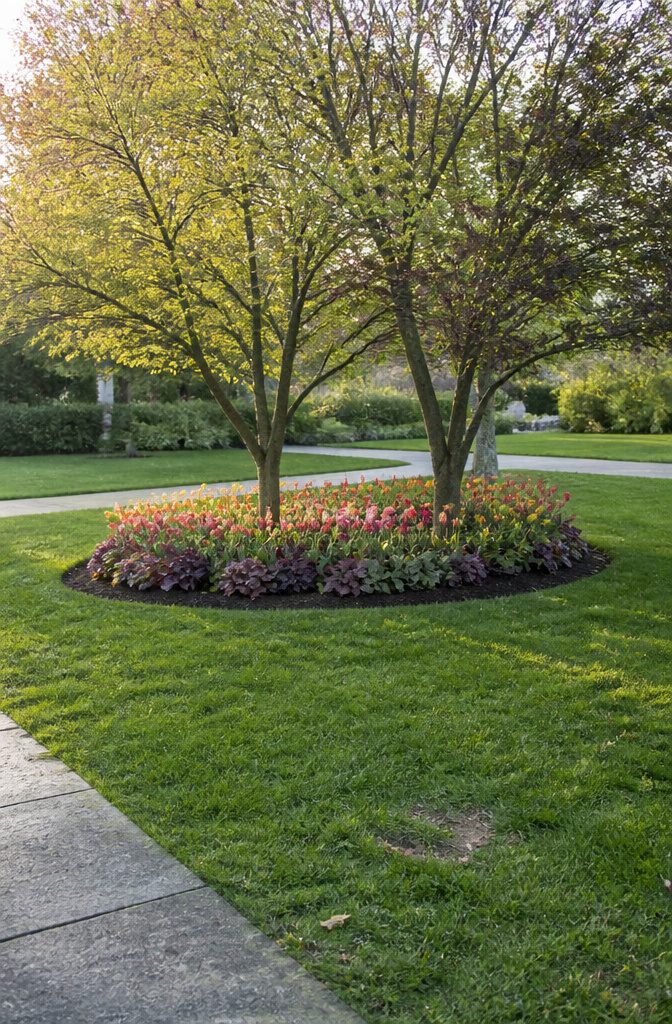
An island bed sits free of the house and walls, so you see it from every side.
Two specimen trees, several kinds of Heuchera and a scattering of tulip bulbs make a simple version for a front yard. The trees are the focal point.
In a modest bed, center them so they draw the eye from the walkway. In a larger bed, set the focal point slightly off-center, which adds interest without looking too symmetrical.
Heuchera fills the ground under the trees. Mixing several kinds gives you different leaf colors and textures that hold the bed together after the flowers are gone.
Plant tulip bulbs among the Heuchera. In spring they push up through the foliage and give the bed its color.
4. Large Corner Bed
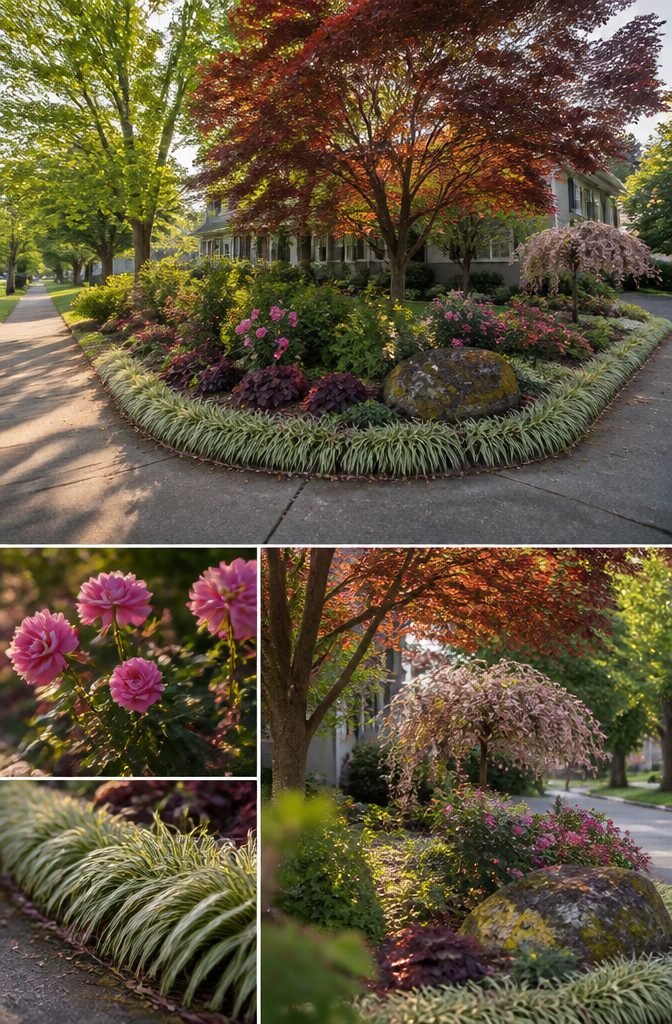
A corner bed this size runs 40–50 feet long and 15–20 feet wide, set a few feet back from the sidewalk.
It suits a big lot, and it costs more to fill than most yards can justify. A bed that size takes a lot of shrubs and at least one tree.
Anchor it with a Royal Red maple. Around it, add Heuchera, roses and Japanese maples, with a weeping type like Goshiki Shidare as a specimen.
Edge the street side with variegated Liriope and carry it around both ends of the bed so the border reads as one line.
At this length, single plants look scattered. Plant Heuchera, roses and the maples in repeated groups so the same shapes return every few feet.
Recommended Products

PLUM HEUCHERA LIVE PLANTS – Beautiful Heuchera featuring rich plum, purple and burgundy foliage with contrasting darker veining for striking landscape color.
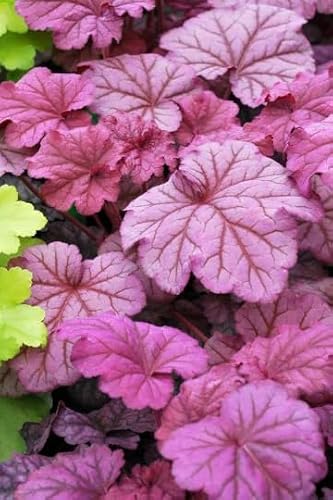
Fast becoming a customer favorite, Berry Smoothie Heuchera boasts 4 – 5 inch, cheerful, purple-veined leaves that start as a rosy-pink, darkening to hot purple-pink, but retaining vibrant color all season long.

Fast becoming a customer favorite, Berry Smoothie Heuchera boasts 4 – 5 inch, cheerful, purple-veined leaves that start as a rosy-pink, darkening to hot purple-pink, but retaining vibrant color all season long.
5. Plant Shrubs in an Arc
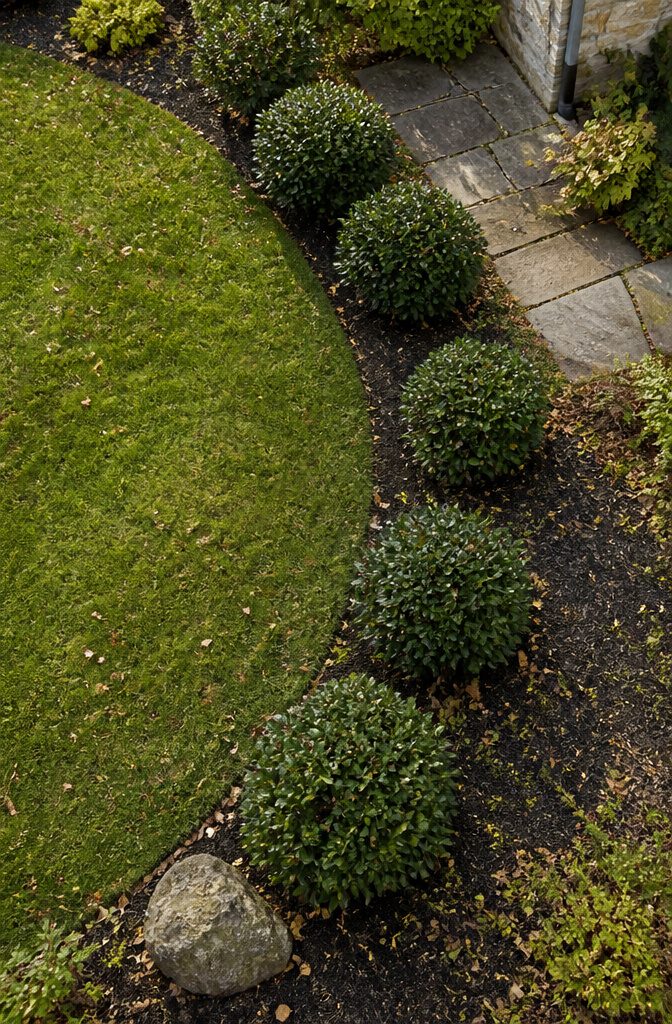
Set the back, center plant first, then curve the rest toward the front on each side of it.
That is why odd counts work: 5 or 7 shrubs give you one anchor with an equal number on each flank, so the arc lays out without guesswork.
An even count leaves a gap where the middle should be, and the row tends to look measured instead of grown.
A straight line of shrubs along a foundation or lawn edge reads like a fence.
A curve breaks that line and gives the lawn a rounded edge. Japanese holly and English holly both suit an arc, including Blue Boy and Blue Girl or Blue Prince and Blue Princess.
Recommended Products
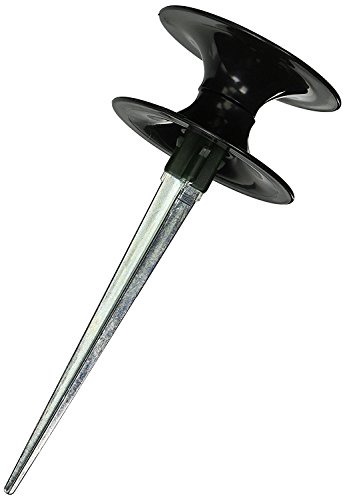
Heavy duty metal stake stays securely in place

Stability: Raised Garden Bed Corner Brackets can increase the stability of your garden bed. These brackets attach at each corner to secure wood or other materials, creating a more sturdy and stable structure.

Sturdy Durable: the raised bed corners brackets is made of nice quality heavy duty carbon steel with an anti rust coating, thick, durable, has good load-bearing capacity, is not easy to deform or break, comes with all of the hardware that you'll need, that easy to assemble; Your flower beds will have a clean, modern look
6. Contemporary Landscaping
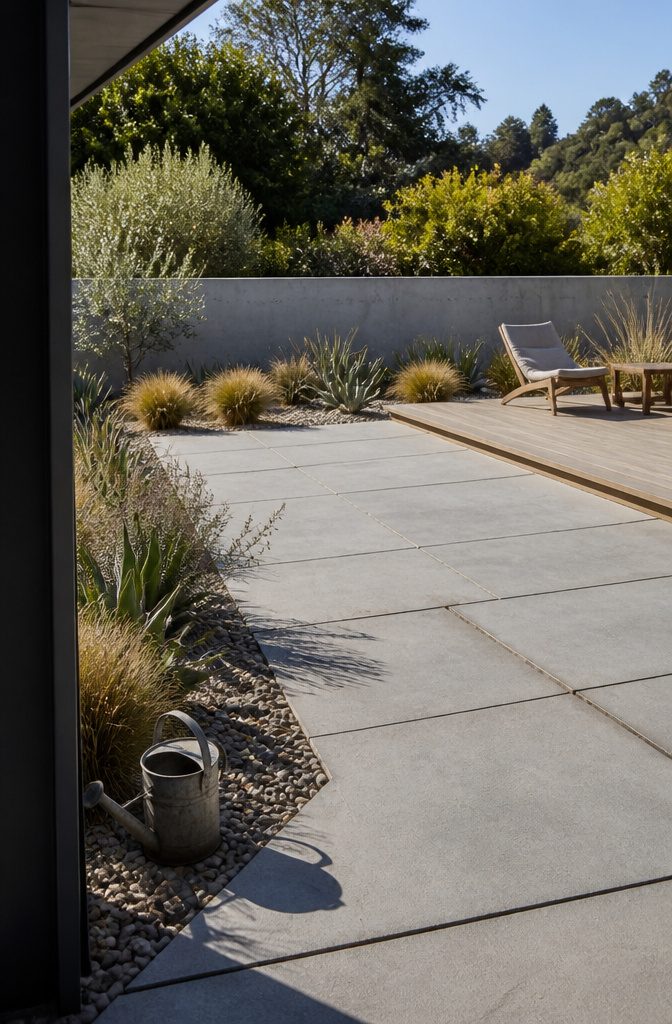
Contemporary design lets the hard surfaces lead.
Clean lines and neutral tones define it, so build the base from cooler-toned materials: concrete, pea gravel and lighter woods. The angles and contrasts between them create the visual interest, and a mostly paved or graveled yard takes little upkeep.
Keep the plantings restrained and repeated.
Choose a few textural plants, such as agave, grasses, palms or White Sage, and repeat them instead of adding one of everything. Furniture should echo the straight lines of the space, so pick simple pieces with no ornament.
This style relies on materials and layout more than on plant variety, which suits a small patio well. If you like collecting plants, you’ll find it limiting.
7. Meadow or Grassland Planting
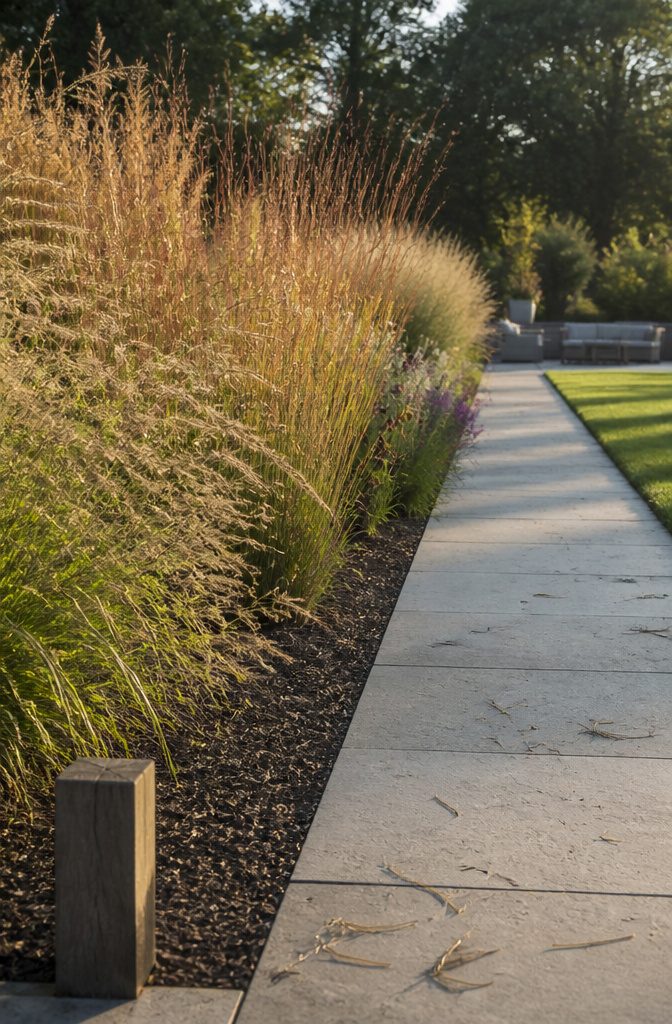
Build the bed on grasses and let everything else play a supporting role. Plant each species in a drift, a large single-species mass, so the pattern reads from the street and from the patio.
Add only an occasional perennial or a single shrub for textural contrast, and keep the mix tight. Fewer, bolder groupings look planned.
Start with natives, since they need the least help from you: Bouteloua gracilis, Schizachyrium scoparium and Panicum virgatum.
For a softer, more modern look, work in Silvergrass, Lomandra, Fountain Grass, Cape Rush, Pink Muhly Grass or Boulder Blue Fescue. Check each against your zone first.
Loose planting needs a firm frame. Run it against a straight path, paved border or sharply cut bed edge, then cover bare soil with a solid layer of mulch.
8. Tropical Planting
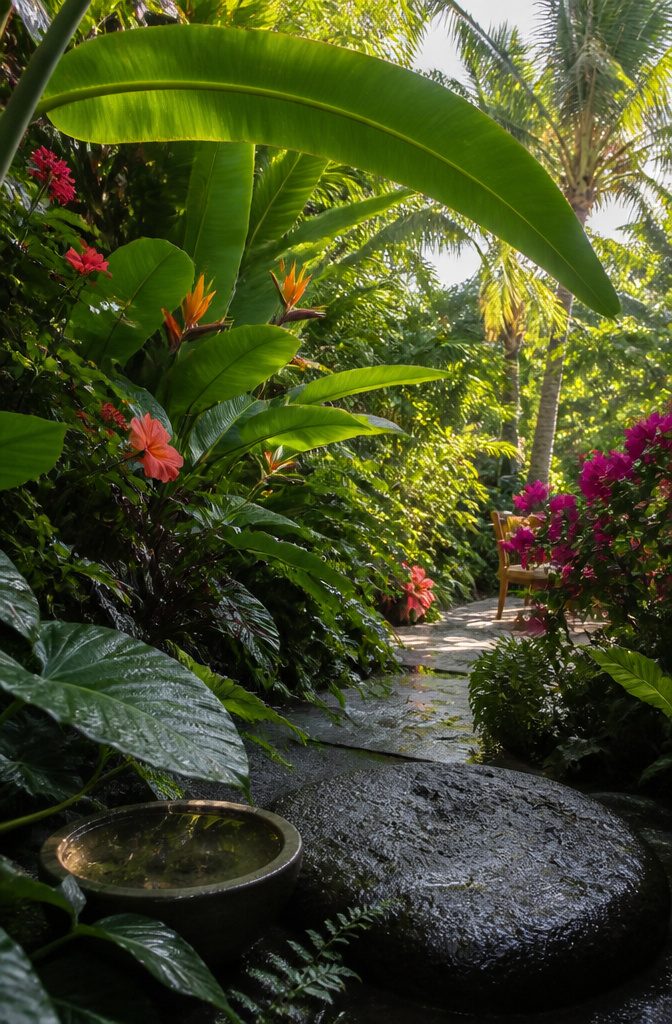
Tropical planting looks lush because there is almost no open ground.
Layer the plants and intermix them: tall palms and giant bird of paradise for height, large deep-green leaves for bulk, and Hibiscus or Bougainvillea for the occasional burst of bold color.
Many of these species evolved under tree canopies, so they tolerate some shade, but most also want plenty of water.
True tropicals need a mild climate or winter protection, such as pots moved indoors or covers on cold nights.
In a dry region, choose lower-water plants: drought-tolerant palms, pineapple guava and red hot pokers. Giant bird of paradise and Bougainvillea also handle dry spells.
Recommended Products

Durable Metal Construction: SnugNiture garden edging is made of high-quality metal materials. It is strong and durable, capable of withstanding outdoor sunlight, rain, and snow. Thus, it has a long service life.

PRODUCT DETAILS: Gardener's Supply Raised Garden Beds Aluminum Corners - Set of 4. Our ingenious Raised Bed Corners are weatherproof aluminum brackets that can steadily hold heavy weights of soil/plants and can be used to extend the length/width of our outdoor planter box. A reliable accessory for raised beds gardening.

CREATE A CAPTIVATING SPACE – The versatility of moving the location of your garden to best fit your landscaping needs provides years of satisfaction. The corner posts are reliable and durable in the outdoors. They provide clean lines for a finished look to any garden.
9. Xeriscape and Desert Planting
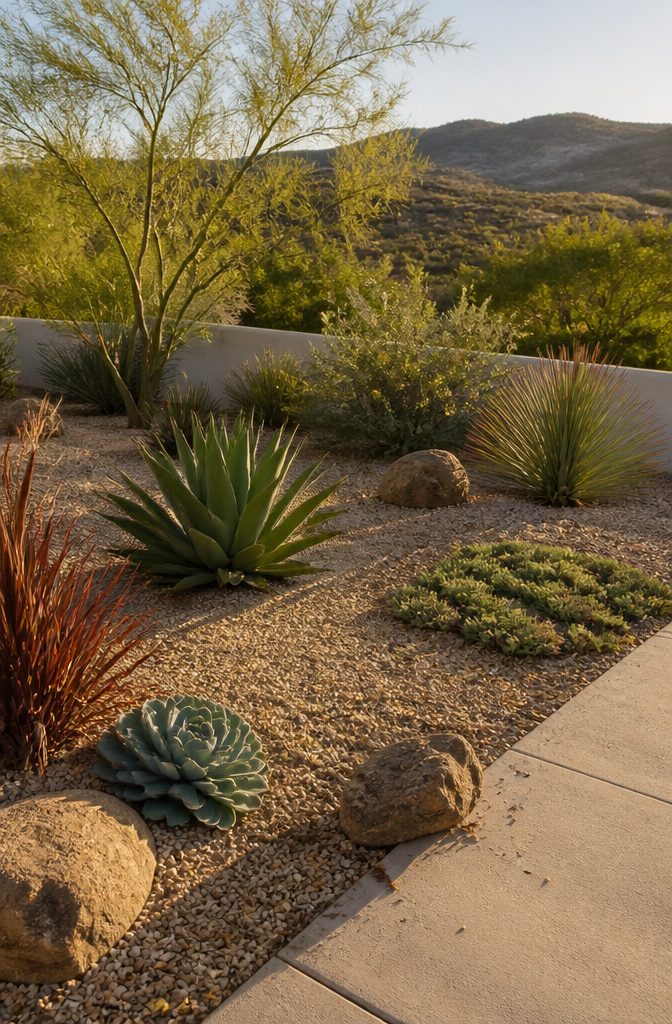
Xeriscape pairs permeable gravel or mulch with native or climate-adapted plants that need little to no irrigation.
For the desert version, leave open space between plants and fill the gaps with gravel, individual boulders about 2 feet long, or limited mats of Sedum. Tan gravel is the safe mulch because it matches tan decomposed granite.
Give each bold plant its own room.
Agave attenuata, Echeveria elegans, Aloe ‘Blue Flame’, Red Yucca, New Mexican Privet and Desert Museum Palo Verde all work as accents, and crowding them together cancels the effect. Better too open than too stuffed.
A formal modern take uses rectangular planting spaces, straight concrete paths, rows of succulents, corten steel and uplighting.
Recommended Products
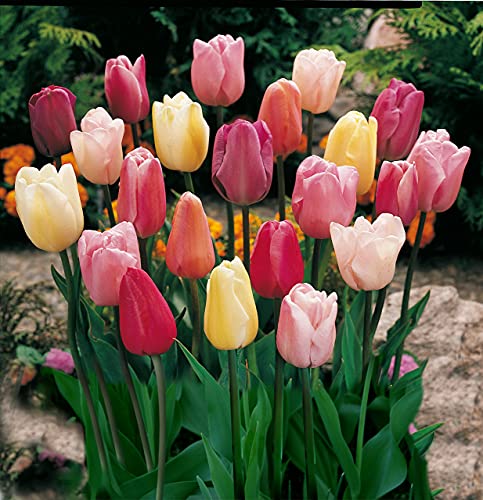
Multi Colors in spring

A classic red tulip must have for every garden

100 TULIP BULBS IN ASSORTED COLORS: A stunning blend of early, mid, and late-season tulips in a variety of bloom shapes and colors.
10. Southwestern Style
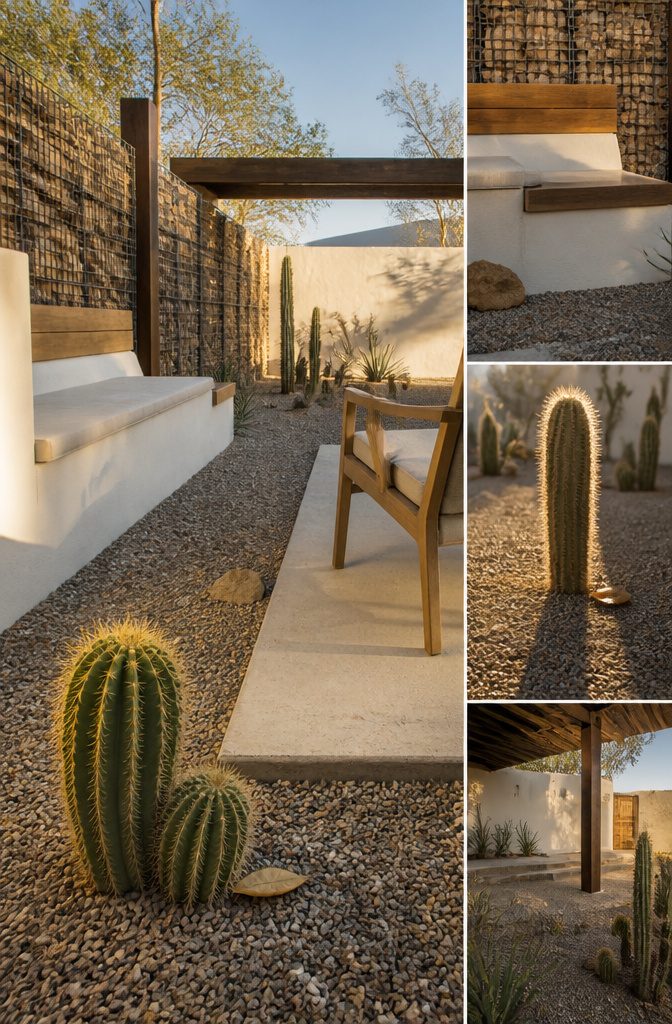
Southwestern style relies on hardscape first and plants second. Warm white built-ins, such as a bench, a fireplace surround or a low planter wall, give the yard its backbone.
Gabion walls, which are wire cages packed with stone, add rough texture, and wood warms the white and gray around it.
Pea gravel makes up the ground layer, and it crackles underfoot in a way a lawn never will.
Set a few cactus directly into the gravel and leave bare space between them. Keep the planting sparse and let the walls, wood and gravel carry the look.
Crowd in more plants and the yard reads as an ordinary garden. Loose gravel also makes patio chairs wobble, so give seating a solid pad.
Combine Four Style Terms
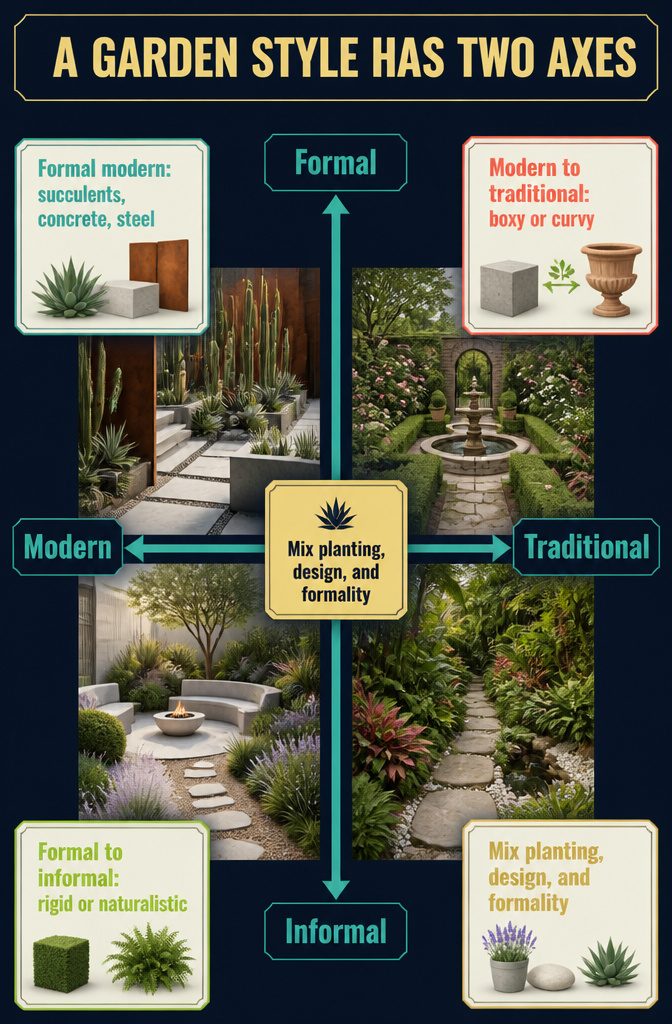
A yard’s style comes from planting, materials, furnishings and decor working together. Two scales help you describe what you want:
- Modern to traditional is the x axis. Ask whether your design is boxy, curvy, or somewhere between.
- Formal to informal is the y axis. Ask whether the planting is rigid and geometric, or loose and naturalistic.
- A formal modern desert yard has rectangular spaces, straight concrete paths, rigid rows of succulents and corten steel accents.
- An informal traditional tropical yard has loose ferns, perennials and trees, with natural stone walkways and white rock.
- Named styles are not fixed. Mix planting style, design style and formality to suit your yard. Most people land in the middle, such as a modern look with a few traditional accents.
Start a Bed With 6–8 Inches of Soil
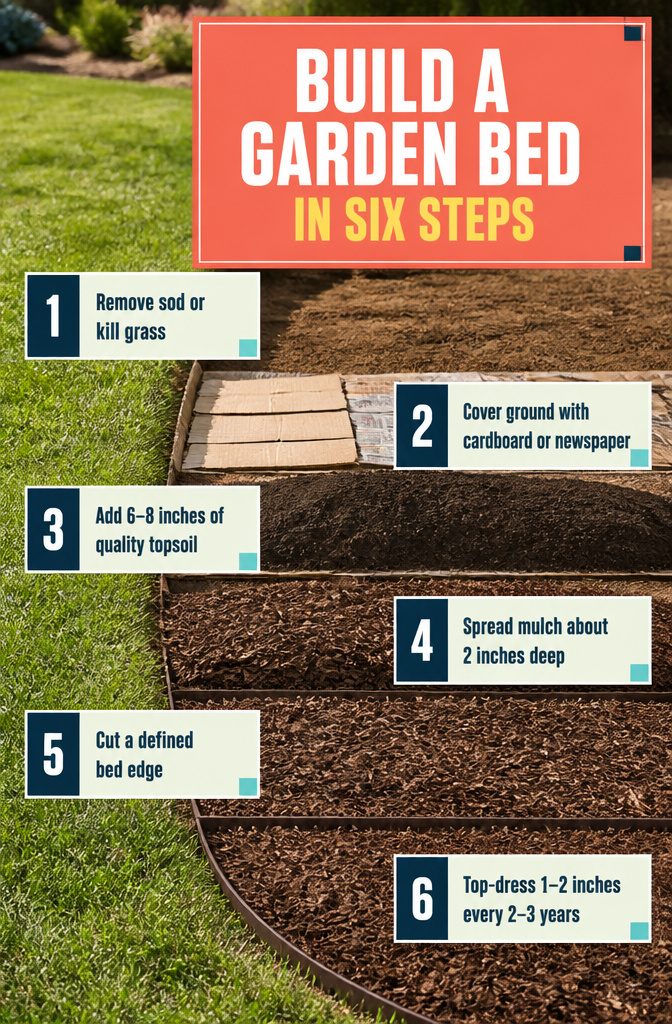
- Remove the sod, or kill the grass where it stands.
- Cover the ground with cardboard or newspaper. Skip landscape fabric: weed barriers don’t work, and nothing non-organic belongs under mulch.
- Add 6–8 inches of quality topsoil. A raised bed usually drains better and looks cleaner than a level one, so mound the soil if your yard stays wet.
- Spread mulch about 2 inches deep.
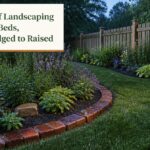
- Cut a defined edge along the bed so the lawn and the mulch stay separate.
- Top-dress with 1–2 inches of mulch every second or third year, after the old layer has broken down. Pull weeds and trim plants as needed.
Frequently Asked Questions
How do I design my own garden layout?
Start by placing your style on two scales: modern to traditional (boxy or curvy) and formal to informal (rigid and geometric or loose and naturalistic).
Most yards land somewhere in the middle, such as a modern look with a few traditional touches. Then plant in repeated groups and give each bed one focal point, such as a specimen tree.
What is the rule of 3 in landscaping?
Plant in groups of 3, 5, or 7 instead of scattering single plants, which tend to look like clutter.
Treat odd numbers as a loose guideline, not an exact formula. Repeating the same group farther down the bed links the clumps into one planting.
Where should I place a focal point in a garden bed?
In a modest bed, center the focal point, such as a specimen tree, so it draws the eye from the walkway.
In a larger bed, set it slightly off-center for interest without too much symmetry. The end of a walkway also works, since the eye goes there naturally.
How do you start a new landscape bed from scratch?
Remove the sod or kill the grass where it stands, then cover the ground with cardboard or newspaper.
Add 6–8 inches of quality topsoil and finish with about 2 inches of mulch. Skip landscape fabric, because weed barriers don’t work well.
How deep should the soil be in a landscape bed?
Use 6–8 inches of quality topsoil. It goes over the cardboard or newspaper layer and under roughly 2 inches of mulch.
Should landscape beds be raised or level with the yard?
Raised is usually better.
A raised bed tends to drain well, makes plants stand out, and looks cleaner than a level one. If your yard stays wet, mound the soil.
How do you keep landscape beds looking clean and maintained?
Cut a defined edge between the lawn and the mulch, and keep the mulch about 2 inches deep.
Pull weeds and trim plants as needed. Every second or third year, once the old mulch has broken down, add another 1–2 inches on top.