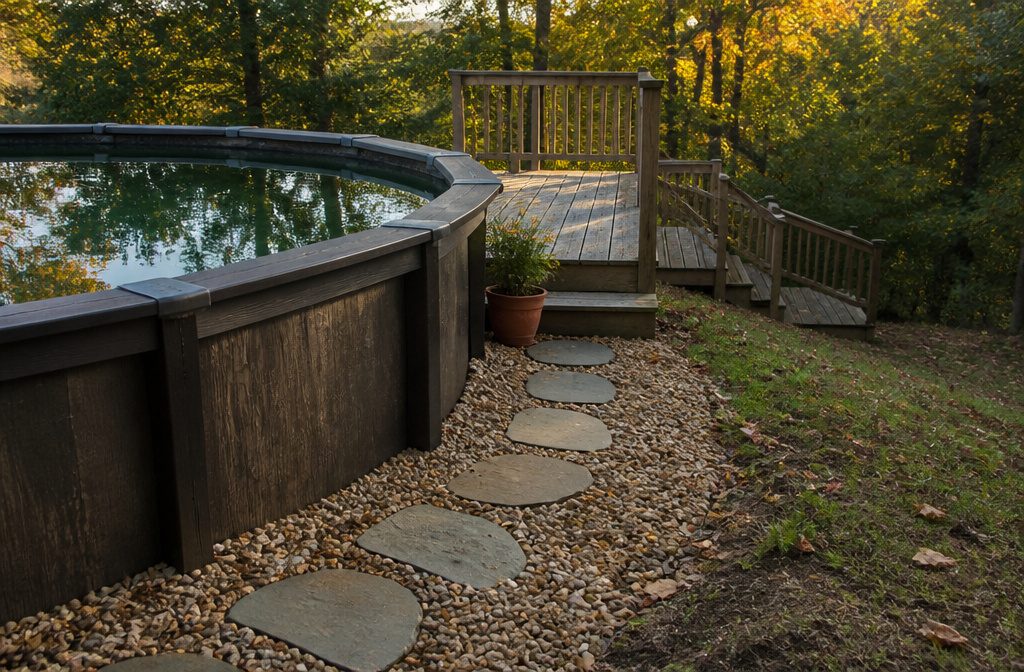
Choices run from a gravel border to a multi-level deck, and the right one depends on your budget and how level your yard is.
Pavers need a compacted, level base, which usually means hiring a professional. Pressure-treated wood is the cheapest decking, but only if you will seal it every year.
1. Artificial Turf
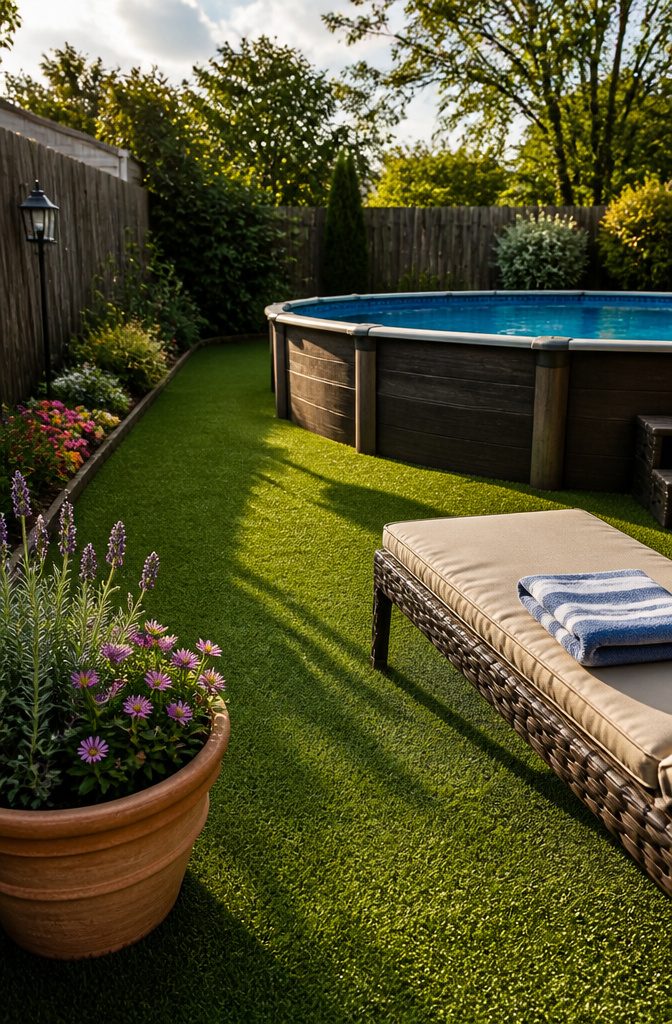
Artificial turf gives you a soft, green surface around the pool or over the deck, with no mowing and no watering.
It makes a comfortable spot for lounging, and it is one of the more affordable ways to finish a pool area.
Hire a professional landscape company to install it. A poor installation can damage the pool or the ground around it, and avoiding that damage saves you money later.
Turf is a surface cover, not a living planting. It gives you no blooms, no seasonal change, and nothing for wildlife.
To bring that back, set flower beds or potted plants along its edge. The color against the green also makes the area look more natural.
Recommended Products

【Sized the Shape by Yourself】Pick For Life artificial turf grass outdoor comes with gardening gloves, which is easy to cut with scissor. You can cut the outdoor turf grass according to your needs to match the garden/backyard/balcony/patio/deck perfectly.

【Realistic Appearance & Eco-Safe Material】Our premium artificial grass features a rich green color with a soft, natural texture. Crafted from premium PE/PP blend with UV stabilizers, our turf resists fading and degradation under intense sunlight or heavy rain, offering a realistic lawn look year-round. Non-toxic composition ensures pet and child safety during playtime.

TURFLOID Artificial Grass: Premium ultra-realistic synthetic turf grass that stays soft and lush year-round. Weather-resistant, low-maintenance fake grass for effortless lawn aesthetics and alternatives
2. Gravel, Rock, and Mulch Borders
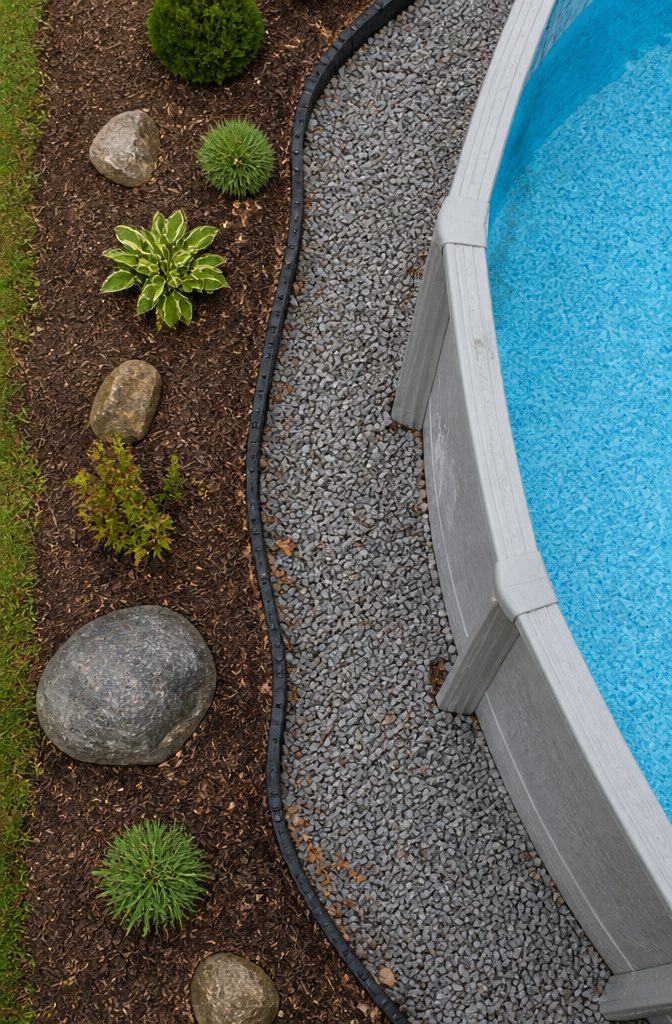
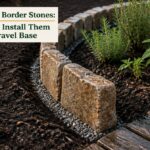
Gravel is the cheapest way to give an above-ground pool a clean edge, and it is easy to install. Lay a tarp or weed barrier first, then set an edging so the stones stay put.
One video walkthrough used almost 90 feet of stake-in, hook-together faux rock border around an 18-foot pool. The owner wished she had chosen a black tarp instead of blue, since it shows less.
Gravel drains, so splashes soak away instead of pooling against the wall. Keep stones out from directly under the pool’s belly, because owners worry that rock can put holes in the liner.
Mulch does a different job: it holds moisture in planted beds. Larger rocks also work as a decorative bed.
Recommended Products

Long-Lasting Use: Made of high-quality, weather-resistant plastic, this landscape edging is both sturdy and flexible enough to hold pebbles, mulch, and other materials in place

Durable & Flexible Material GTSABWAY garden edging is Made from high-quality metal, ensuring superior durability and flexibility. Easily shape it into straight lines,curves, circles, or unique contours ,without cracking,Can withstand all kinds of weather conditions, ensuring long-term durability and reliability. providing reliable Garden Border solutions.

SIZE:Landscape edging is 33ft/10m length & 4in/10cm height; with 50pcs 8-inch spiral spikes.
3. Potted Plants and Shrubs
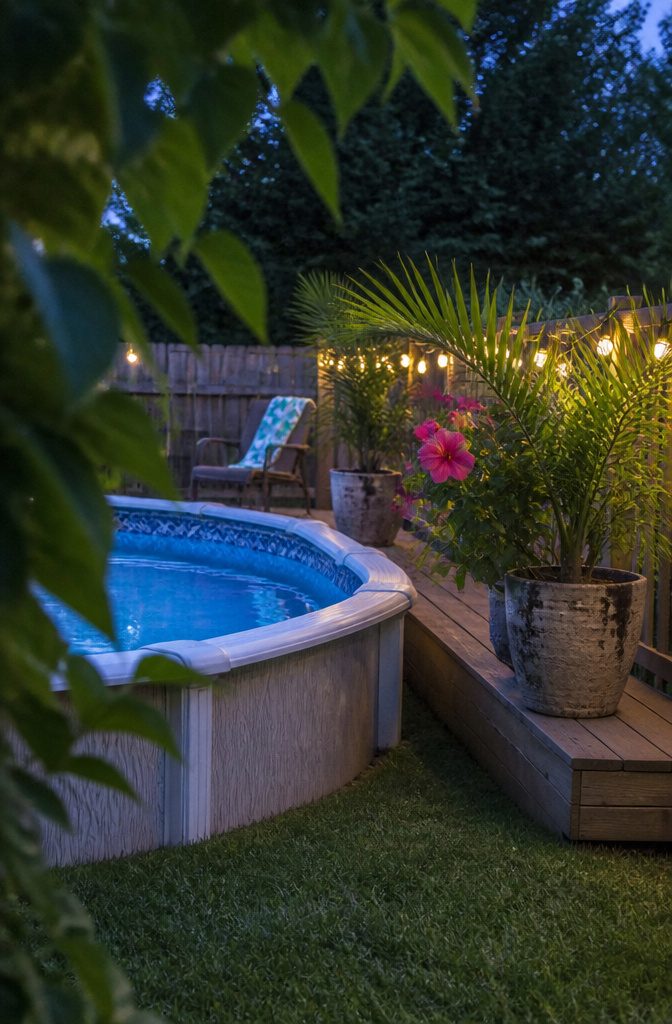
Pots add greenery without any digging, and you can rearrange them whenever the layout stops working. Set them along the deck edge, against the fence, or on top of the pool wall.
Large pots of hibiscus or palms give you a tropical look that stays movable, so you can shift them out of harsh sun or bad weather. Whatever you choose, pick low-maintenance plants that suit your climate.
A plant that needs daily fussing is the first to fail by midsummer. A few big pots look better than a crowd of small ones, and they dry out more slowly.
Run string lights near the pots. In the evening the glow picks out the foliage and gives the pool area a softer, cozier look.
Recommended Products

Artificial Boxwood Topiary: The foliage is carefully crafted into a dense, symmetrical tree shape that sits atop a visible, natural-looking trunk, replicating the timeless charm of a living boxwood standard. Standing at a total height of 23.6 inches, including a sturdy metal ground stake for secure installation, the lush green foliage ball itself measures 20 inches tall and 14 inches wide at its fullest point.

【Multi-Styles Selection】These artificial cypress topiary ball trees have a realistic look, and each faux shrub plant comes with a quality black ground spike. Of course, to better match the style of your house, you can place them in any matching pots or stick them directly in the dirt.

【Grooy ARTIFICIAL TOPIARY TREE】This set of 2 faux topiary balls adorned with delicate boxwood leave. Total dimensions (including spikes) are 27.5"H x 17.7"W. For instant beauty, simply fluff the foliage and insert the stakes into your planter or ground
4. In-Ground Planting Around the Pool
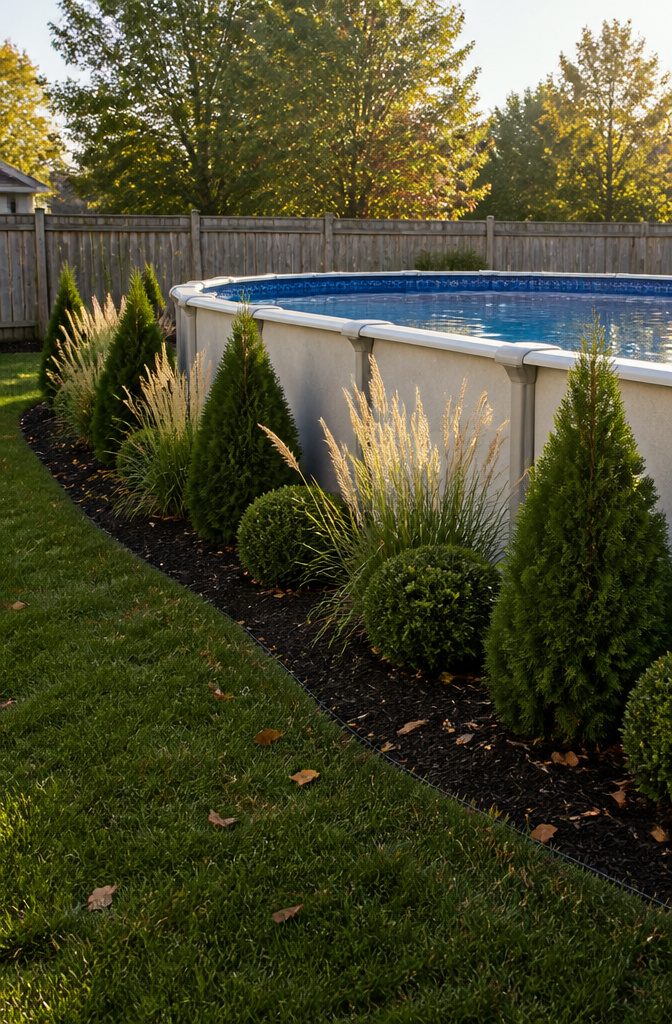
Arborvitae and boxwoods stay green all year and hold their foliage, so they won’t drop leaves into the water. That means less skimming for you.
Against the pool wall, plant Feather Reed Grass or Maiden Grass. They grow quickly to 3–5 feet, tall enough to hide the side panels and soften the hard lines, and the blades move in a breeze.
Keep large trees with aggressive roots 6 to 10 feet from the pool.
Roots that close can compromise the liner or the wall’s stability. Near the edge, stick with shrubs and grasses.
Spread mulch over the beds to hold moisture around the roots.
Recommended Products
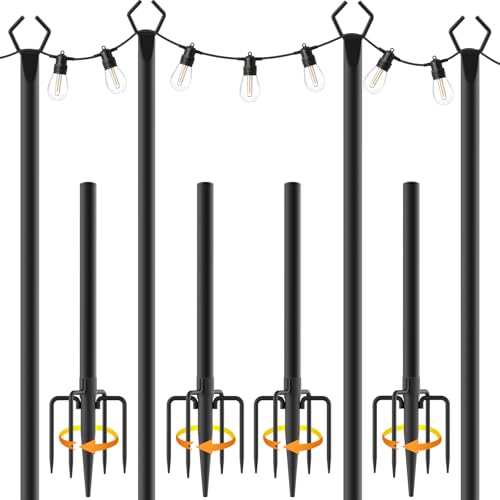
No height restrictions:Made of high quality metal, it will not bend or wobble. The poles for string lights is not limited by its own length, and the excellent load-bearing properties allow you to install it on high fences and walls. Get rid of the general height limitation. You can also hang more number of strings of lights. Also can be applied to banners, lanterns, wind chimes, all kinds of light decoration, etc.

Smart remote control: No need to adjust it with effort,one click switches brightness(from a warm dim glow to bright illumination), set 3/6-hour timer(turn on before bed,automatically turn off at dawn to save energy), and instantly switch between 3modes: flashing (festive vibes),breathing(romantic date),and constant on(nighttime safety).Whether hung on eaves,fences or treetops,You can precisely control the string of lights with remote,even seniors and children can also use it easily

200FT Extra-Long size:Most string lights on the market are only 50-120ft size,For large yards,pool sides,or long fences often require multiple strings to be connected,resulting in tangled wires and potential poor contact.Our 200ft extra-long string light can wrap around an entire tree,cover an entire patio,or even illuminate a medium-sized garden with one string lights,no splicing needed,Installation is time-saving,making the decor looking seamless and attractive.
5. Deck Surrounds and Multi-Level Decks
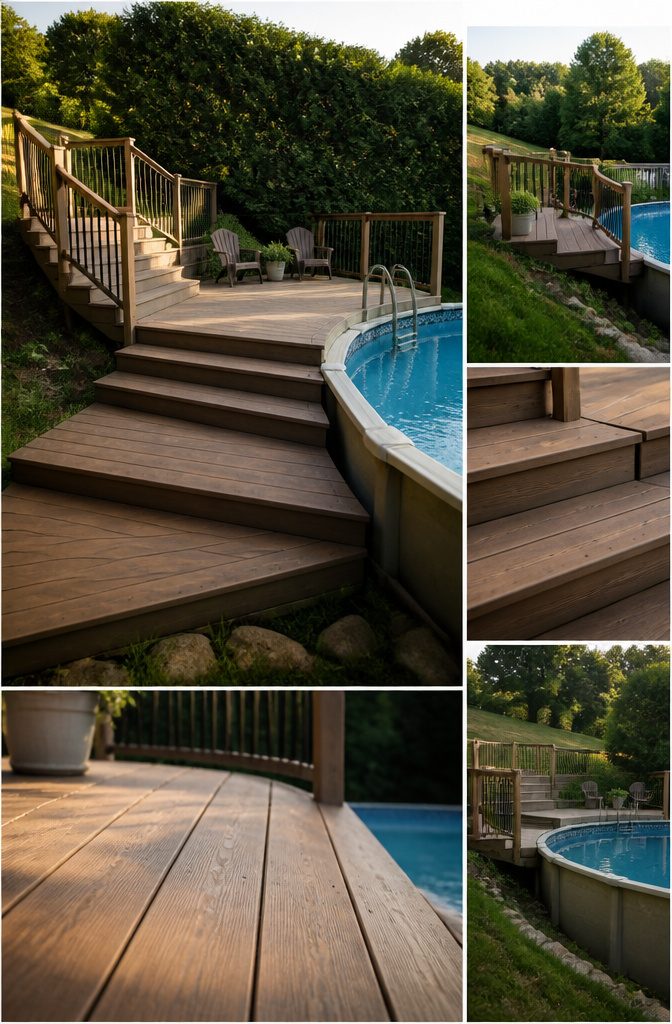
A full wraparound deck makes the pool look sunken.
A partial side deck costs less and still gives you a lounging spot. On a slope, set the pool into the hill and step a multi-level deck down to the water, which avoids heavy excavation.
| Material | Strength | Drawback |
|---|---|---|
| Pressure-treated wood | Most affordable | Annual sealing; can splinter |
| Cedar | Rot resistant, stays cooler | Costs more |
| Composite (HDPE) | Low maintenance, no splinters | Higher upfront cost; hot in direct sun |
| Pavers or stone | Excellent drainage | Professional installation, level base |
On a small budget, choose pressure-treated wood, but only if you will seal it every year.
Recommended Products

【Sized the Shape by Yourself】Pick For Life artificial turf grass outdoor comes with gardening gloves,which is easy to cut with scissor.You can cut the outdoor turf grass according to your needs to match the garden/backyard/balcony/patio/deck perfectly.

【Durable & High-Quality Material】: Crafted from premium PE&PP materials, this artificial grass indoor outdoor is built to last. It features UV protection and a sturdy four-layer backing to stay green and intact through sun, rain, and all seasons, without fading or damage

【Sized the Shape by Yourself】Pick For Life artificial turf grass outdoor comes with gardening gloves, which is easy to cut with scissor. You can cut the outdoor turf grass according to your needs to match the garden/backyard/balcony/patio/deck perfectly
6. Pavers, Stone, and Pathways
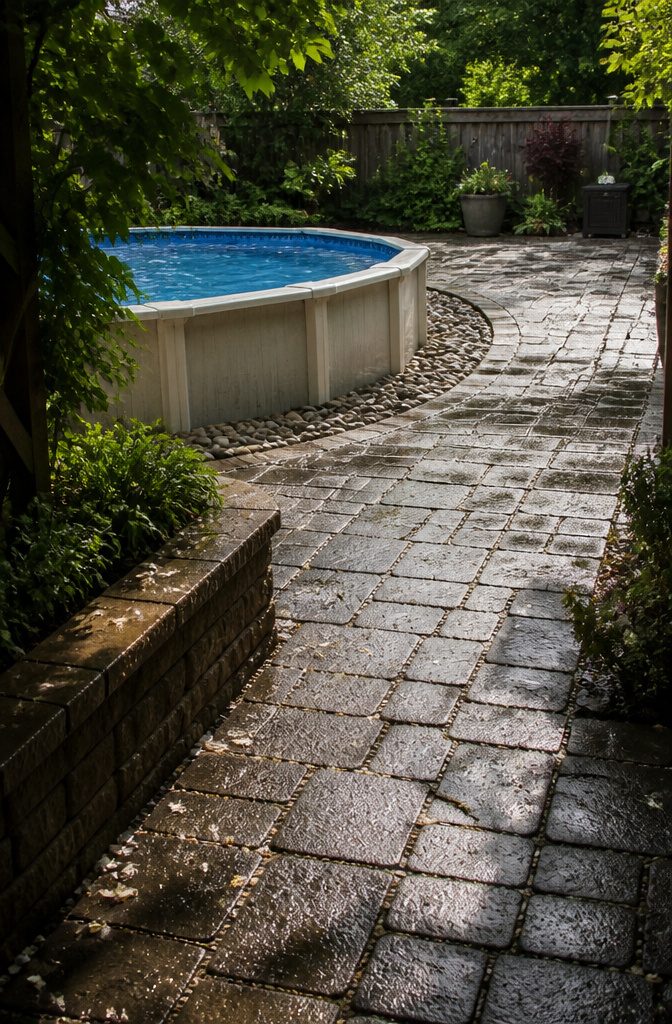
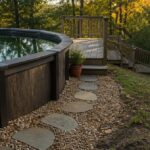
A paver or flagstone apron around the pool makes the area read as a planned space instead of a tub set on the lawn.
Pavers and natural stone both drain well, so splash and rain soak through the joints instead of pooling against the pool wall and turning the ground to mud.
Everything depends on the base.
Pavers need a compacted, level base, because any settling shows up as rocking stones and uneven joints. That is why a professional installer is the better call here, not a weekend DIY job.
Run a path from the house or patio to the pool in the same material. Choose a textured, non-slip surface, since smooth polished stone gets slick under wet feet.
Recommended Products

Quality Metal Material: Our galvanized garden edge is processed using high-precision CNC technology, ensuring accuracy down to every millimeter. Innovative 3D ripple design not only enhances the aesthetic appeal of the fence but also strengthens its structural integrity.

【Create Clean Landscape Borders with No Dig Installation】Create neat, professional-looking edges around flower beds, lawns, pathways, and garden features without trenching or heavy digging. Simply position the edging and secure it with the included spiral spikes for a fast DIY landscape upgrade.

100FT KIT WITH 150 STAINLESS STEEL STAKES: Includes two 50FT rolls of flexible landscape edging and 150 rust-resistant stainless steel stakes to help anchor borders more securely than standard plastic stakes.
7. Privacy Screens and Living Walls
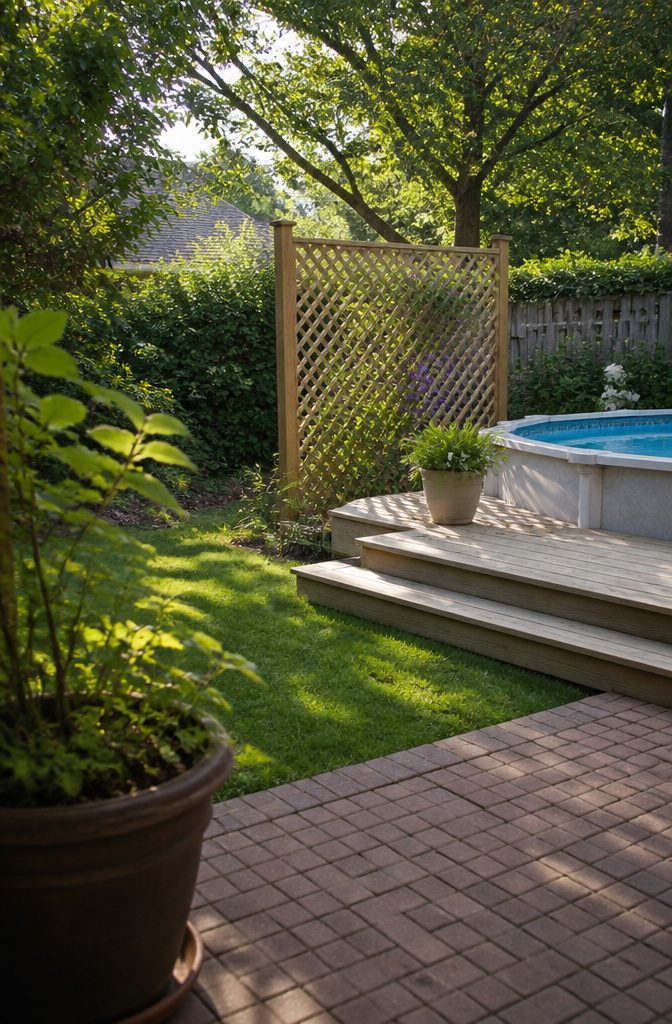
Lattice is a budget-friendly way to block sightlines, and it works best placed only where eyes actually land: the fence stretch facing a neighbor’s upstairs window, or the corner beside the deck.
Screen those spots and leave the rest open, so the yard doesn’t feel boxed in.
Plant clematis or ivy at the base and the panel becomes a living wall, lush and private instead of a flat barrier. Clematis suits a small yard better because it stays tidy on the lattice.
Ivy covers faster but spreads hard, so keep it trimmed and away from the pool wall. Expect a bare-looking panel for the first season or two while the vines fill in.
8. Layered Outdoor Lighting
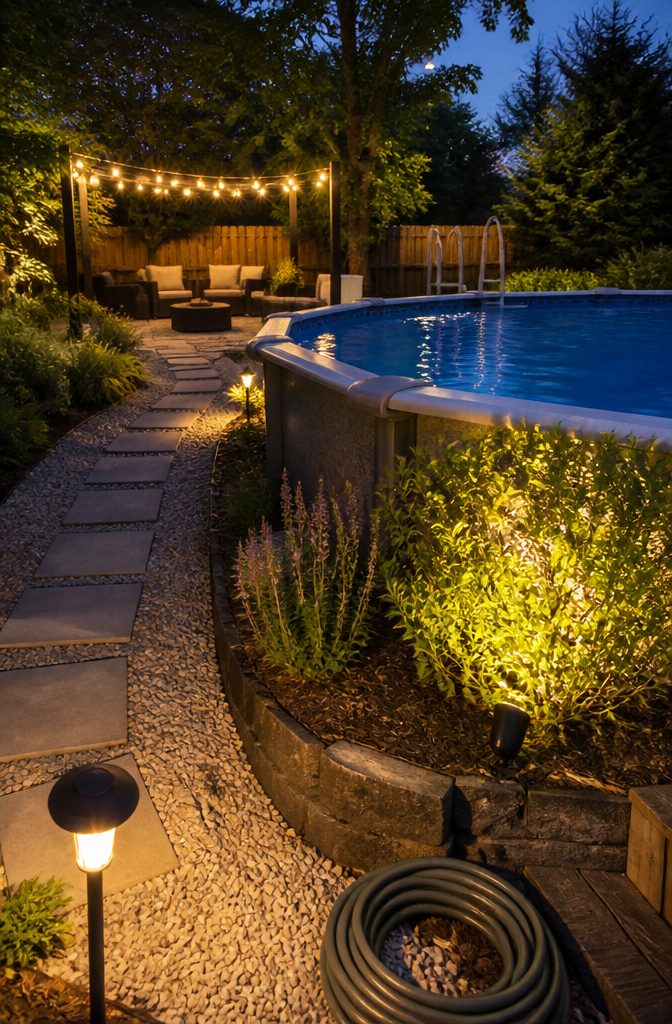
Three layers of light do three different jobs.
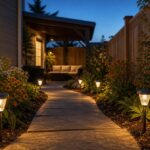
Path lights come first. Set along the walkway to the pool, they show you where the ground changes and cut down on trips after dark.
String lights add the mood. Hang them over the seating area, or drape them near potted plants, where a soft glow against the leaves feels cozy.
Accent lights go last: aim one up into a tree, shrub, or fence panel so the yard has depth past the pool’s edge.
Put each layer on its own switch or timer, so you can run only the strings for a quiet evening and add the rest for company. Choose warm white bulbs throughout.
Recommended Products

For Low-Profile Outdoor Accents: 16.4ft Cool White 5000K strip with 150 LEDs fits patios, steps, deck edges, shelves, coves, counters and trim lines

【UPGRADED! Remote Control】 Our advanced remote control marries ease with innovation for next-gen solar string lights:3 Brightness Mode: Soft/Bright/Super Bright, 3 Light Mode: Breathing/Flashing/Constant, 4 Timing Control: 2/4/6/8 Hrs.One remote, endless charm—no extra timers and dimmer required,Elevate your outdoor oasis effortlessly.

【Convenience for 100-240 Voltage】Outdoor string lights with remote control offer the convenience of easily turning the string lights on and off from a distance (50FT)With the remote control, you can effortlessly control the outdoor lighting without having to physically reach the outdoor lights source or use additional plug in dimmer switches.input 100-240voltage, output 24v
9. Separate Activity Zones
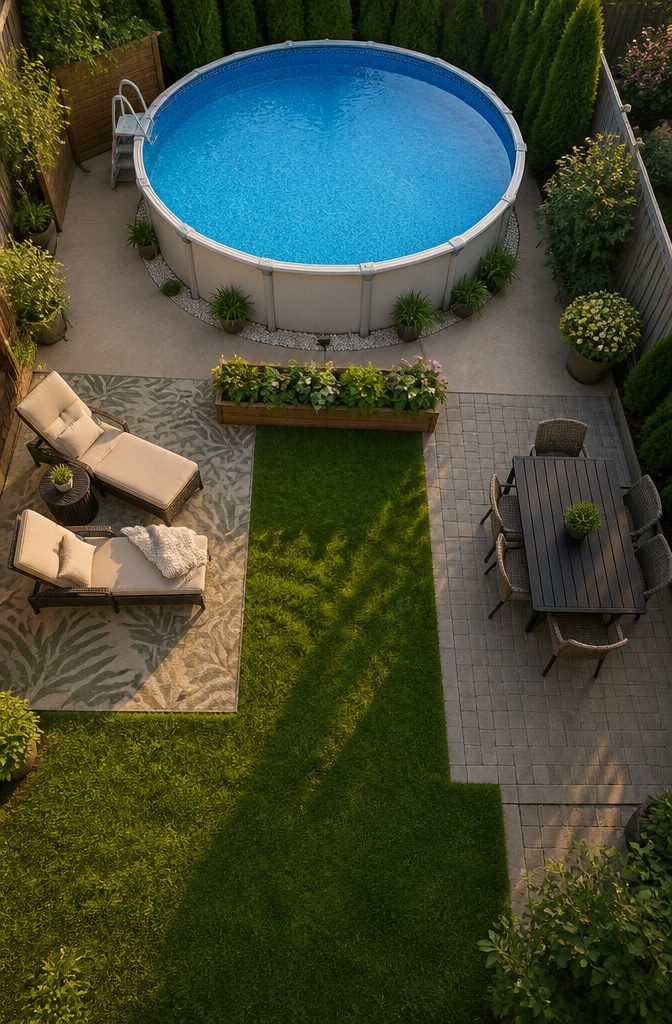
A pool set in open lawn reads as an object.
Give it two neighbors and it reads as a layout. Put lounging on one side, where chairs sit on a soft surface, and dining on another, so people carrying plates to the water don’t cut through the chairs.
Keep the swimming zone clear, with the pool as the only feature in it. Mark each area with a change in ground surface, a planter, or a strip of lawn, so the eye sees three places.
Well-integrated pools can add up to 7% to a home’s value, but only when the pool is kept up.
Recommended Products

【Realistic Appearance & Eco-Safe Material】Our premium artificial grass features a rich green color with a soft, natural texture. Crafted from premium PE/PP blend with UV stabilizers, our turf resists fading and degradation under intense sunlight or heavy rain, offering a realistic lawn look year-round. Non-toxic composition ensures pet and child safety during playtime.
Easy to clean: shake, sweep, hose, or machine wash. This astroturf for dogs is a reusable artificial grass mat, keeping turf grass for dogs fresh. Fake grass for dog dries fast to cut odor and upkeep.
【Durable & High-Quality Material】: Crafted from premium PE&PP materials, this artificial grass indoor outdoor is built to last. It features UV resistant and a sturdy four-layer backing to stay green and intact through sun, rain, and all seasons, without fading or damage
10. Fire-Pit Gathering Area
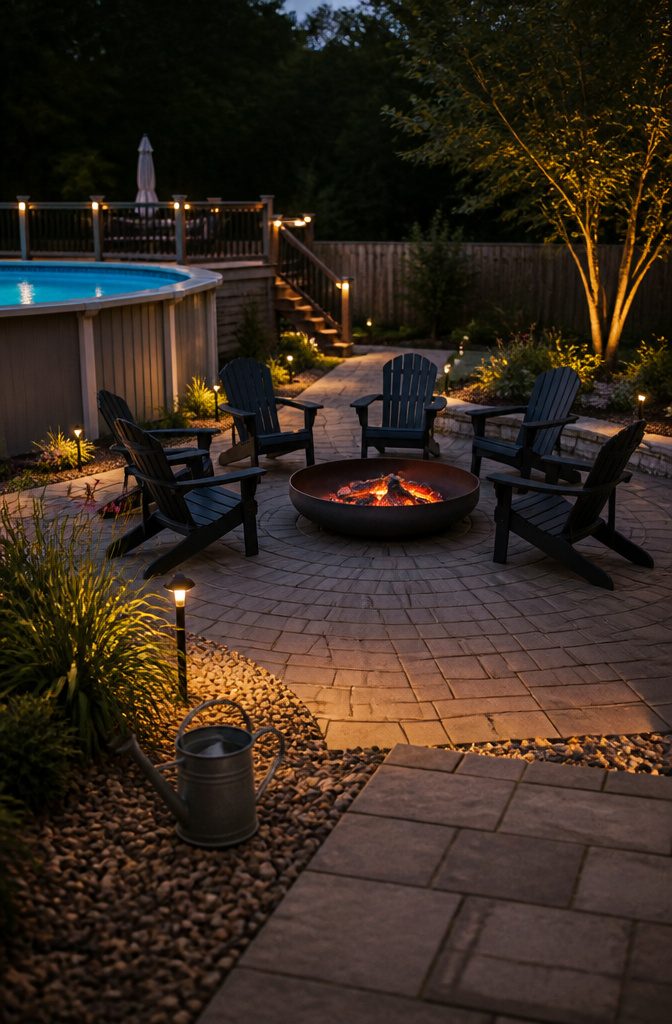
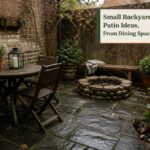
An above-ground pool goes quiet at dusk, and a fire pit gives the yard a second job once the swimmers dry off. Build it on a gravel or paved pad rather than grass, so stray embers have nothing to catch.
Gravel costs less and goes down faster. Pavers cost more but stay level under chair legs and feel better on bare feet.
Either way, keep the pit well back from the pool wall, deck, fence, and any screens, because heat and sparks can damage vinyl and wood. Check your local burn rules before you buy.
Give the pad its own ring of seating, separate from the wet area, and light the path between the two so the walk over is easy after dark.
Recommended Products

【READY TO USE MULCH BINDER — NO MIXING, NO MESS, JUST SPRAY】 Skip the measuring cups and complicated ratios. This ready to use mulch binder comes pre-mixed for fast application straight from the bottle. Simply pour into a garden sprayer or use with an electric sprayer (not included) to secure bark, wood chips, pine straw, and decorative landscape materials with less effort and more consistent coverage.

Decorative Brick Red Finish for Rustic Charm: This short wood fence features a warm brick red finish that adds natural beauty and a decorative touch to any outdoor space. Ideal as a wood garden fence for flower beds, pathways, and yard accents.

Size:Quibbay flexible landscape edging is 3.15 inch height and 100 ft length, with 150pcs 6.5 inch spiral edging stakes. Garden edging is great for landscape edging,flower beds, garden pathways, tree rings and grass.
11. Painted or Wrapped Pool Exterior
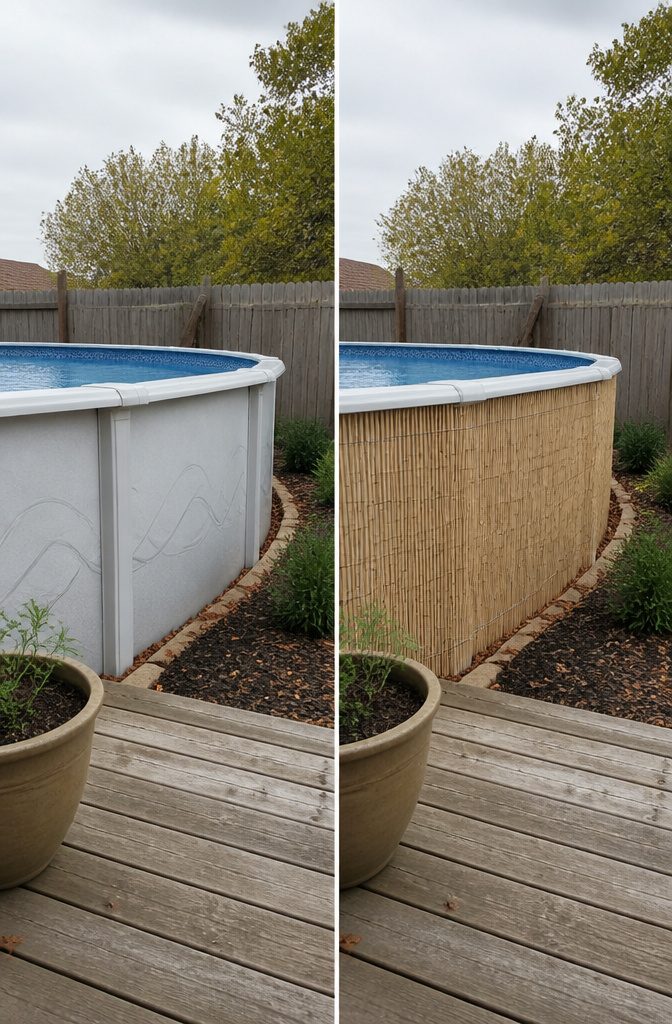
An older pool wall is the first thing you see from the patio, and covering it costs far less than building around it. Two routes work.
Outdoor-rated paint suits a wall that is sound but dated. Clean the surface first so the paint grips, and pick a color that sits quietly beside your fence and decking.
Reed fencing wrapped around the exterior gives a tropical look and hides the wall completely. It is the better choice if the wall is stained or uneven rather than just dull.
Reed can come off again if you tire of it, while paint is harder to undo. If you’re unsure, start with the wrap.
12. Storage and Seating Add-Ons
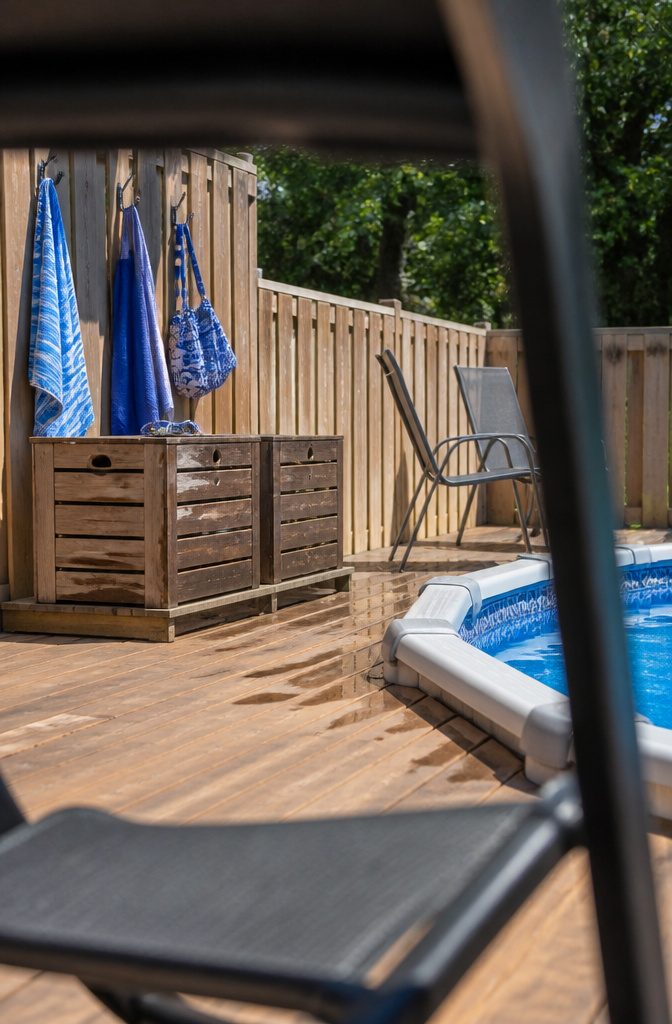
Cheap, simple additions keep wet gear off the deck and give you somewhere to sit that isn’t the pool ladder.
- Repurposed wooden crates hold toys, goggles and noodles. Stack two against the fence or a deck rail, and keep them off the ground on a couple of boards.
- Seal or paint the crates first, and drill a few drainage holes in the bottom. Raw wood that stays damp swells and splits, and wet toys left in a closed box turn musty.
- Hang a row of hooks on the fence or a post for towels and swim bags. It costs almost nothing and clears the chairs.
- Choose lounge chairs with a resin or aluminum frame and a quick-dry sling seat. Wood and thick cushions soak up splashes and stay damp.
- Set the chairs a few feet back from the pool wall so they stay out of the splash zone, still angled toward the water.
- Fold-flat chairs stack against a wall, which keeps a small deck usable.
Fence and Safety Rules
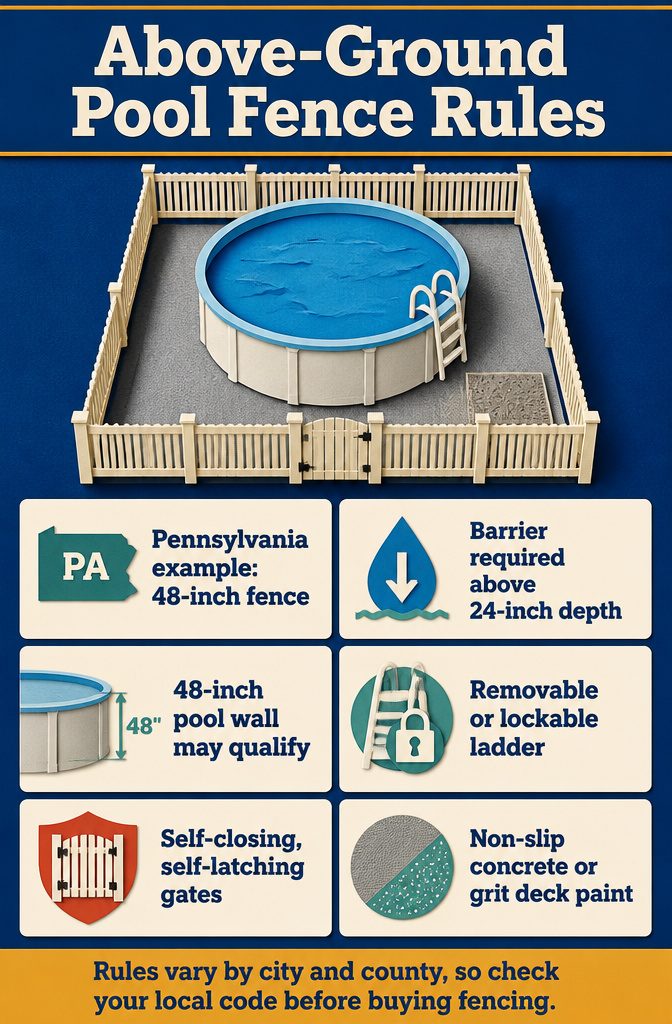
Rules vary by city and county, so check your local code before buying fencing. Pennsylvania offers a typical example:
- A fence at least 48 inches high is required around any pool deeper than 24 inches. Most local codes there, including Wilkes-Barre and Doylestown, apply this to above-ground pools too.
- A pool wall that is 48 inches high may serve as the barrier. The ladder then needs to be removable or lockable so no one climbs in unsupervised.
- Gates should be self-closing and self-latching, especially if children use the yard.
- Surfaces around the pool should be non-slip. Broom-finished concrete and deck paint with a grit additive both work for wet feet.
Pool Care and Winter Prep
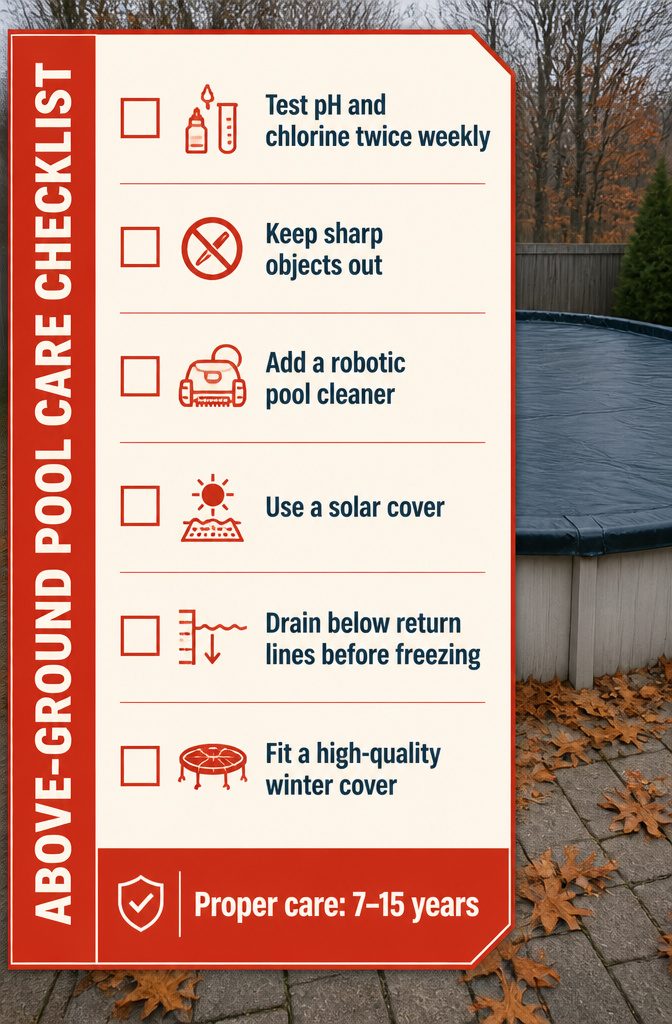
Upkeep protects the plantings and paving you built around the pool, and with proper care an above-ground pool lasts 7–15 years.
- Test pH and chlorine at least twice a week. Steady chemistry prevents algae blooms that can take days to clear.
- Keep sharp objects out of the pool and the water balanced. This stops the liner from turning brittle or stained.
- Add a robotic cleaner. It crawls the bottom and collects sand and leaves.
- Lay a solar cover on the water. It heats the pool from the sun and cuts evaporation.
- Before freezing weather, balance the chemicals and drain the water below the return lines.
- Fit a high-quality winter cover to keep debris out and ice off the walls.
Frequently Asked Questions
What are some privacy ideas for an above-ground pool?
Lattice panels are a budget-friendly choice.
Put them only where eyes actually land, such as the fence stretch facing a neighbor’s upstairs window or the corner beside the deck, and leave the rest open so the yard doesn’t feel boxed in.
Clematis or ivy planted at the base turns a panel into a living wall.
Clematis stays tidier on lattice, while ivy covers faster but spreads hard and needs trimming away from the pool wall. Expect bare-looking panels for the first season or two while the vines fill in.
What is the best natural stone to use around a pool?
Flagstone with a textured, non-slip surface is a good choice. Natural stone drains well, so splash and rain soak through the joints instead of pooling against the pool wall.
Avoid smooth polished stone, which gets slick under wet feet. Stone needs a compacted, level base, so a professional installer is usually the better call than a weekend DIY job.